
Flight (4K UHD Review)
Director
Robert ZemeckisRelease Date(s)
2012 (August 18, 2026)Studio(s)
Paramount Pictures (Kino Lorber Studio Classics)- Film/Program Grade: B+
- Video Grade: A
- Audio Grade: A
- Extras Grade: A+

Review
[Editor’s Note: Dennis Seuling covers the film, audio, and extras portion of this review while Tim Salmons covers the video.]
More than a typical disaster film, Flight is primarily a character study of a man on a downward spiral of addiction who’s responsible for many lives as a commercial airline pilot. The film explores themes of personal responsibility, self-delusion, and family estrangement revealed through a pivotal, dramatic incident.
Captain Whip Whitaker (Denzel Washington) awakens to the sound of an alarm clock in an airport hotel. He fields an angry phone call from his ex-wife about child support, bids farewell to the sexy stewardess with whom he’s spent the night, puts on his uniform, and confidently swaggers toward the Southjet Airlines plane he will pilot that morning from Orlando to Atlanta. Having spent the night drinking and snorting cocaine, he downs coffee and takes a few hits of oxygen in the cockpit to pull himself together.
The plane takes off in a heavy rainstorm. After the weather clears, Whip turns over the controls to co-pilot Ken Evans (Brian Geraghty) and takes a hangover nap but snaps back into command when the plane malfunctions and plunges into a nose dive. Panicky passengers are ordered to put on safety belts and assume crash position. Remaining calm, Whip employs a last-ditch maneuver and miraculously crash lands the plane in an open field so expertly that 96 of the 102 individuals on board survive with minimal harm. Whip is regarded as a hero.
Recovering from his injuries in the hospital, he seeks out his co-pilot and learns from Ken that although his injuries are permanently disabling, he believes the disaster was due not to Whip but to “God’s plan.” Whip also gets a visit from his longtime friend, fellow pilot Charlie Anderson (Bruce Greenwood), who tells him that the crash will be investigated by the National Transportation Safety Board and a blood test conducted in the hospital indicated large amounts of alcohol and cocaine in his system the day of the crash. Shaken, Whip swears off booze and drugs.
In the hospital, he meets fellow patient Nicole (Kelly Reilly), who’s fighting her own demons. Nicole gratefully accepts Whip’s invitation to stay with him at his grandfather’s secluded country farmhouse where he can avoid the media. As the investigation proceeds, Charlie introduces Whip to defense attorney Hugh Lang (Don Cheadle), who lays out a plan to save Whip from facing manslaughter charges and prison for piloting the plane while intoxicated.
Director Robert Zemeckis places the film’s crash sequence at the top of the film, yet manages to sustain suspense throughout as we wonder what will become of the flawed Whip. The script by John Gatins (2005’s Dreamer) explores Whip’s evolving state of mind as the investigation takes unexpected turns. Whip has few real friends other than Charlie and drug dealer Harling Mays (John Goodman). He’s also estranged from his former wife and teenage son, existing on lies and a self-assured veneer.
The technical aspects of Flight are impressive. The out-of-control plane, chaos in the cabin, and the crash landing are created with a combination of mechanical in-camera effects and CGI. Stunt performers help to complete the illusion that we’re watching a real plane speeding to earth as terrified people scream, dangle from seat belts, and get bounced around.
Denzel Washington is exceptional as a man who keeps his addictions a secret until he can no longer hide them. Whip is an expert pilot and believes his drinking and drug use are not impediments to his job. He shows up for work on time, gets his passengers safely to their destination, and takes his responsibilities seriously, but his confidence is shaken when the crash puts the spotlight on him. When Whip is informed that he will be questioned about his activities prior to flying the plane, Washington combines defiance, aggression, and a self-righteous tone. His character’s expertise is being questioned and he his hackles are up. Later, he projects genuine concern and, toward the end of the picture, looks exhausted, physical evidence of the toll that the investigation has taken.
When Whip is under oath during an Aviation Board hearing, he’s a man torn by his conscience, the consequences of his actions, and self-preservation. Denzel Washington, shown frequently in close-up, conveys all of this with precision. His Whip carefully considers his answers to pointed questions. We can see him thinking, vacillating, deciding. His performance in this scene clearly shows a masterful actor conveying much without uttering a single word.
Actress Kelly Reilly is sympathetic as Nicole, a lost soul who refuses to be taken advantage of. Nicole is a contradiction—a drug addict who’s otherwise strong, independent, and confident. She and Whip bond because of their substance dependence, though Nicole owns up to it while Whip denies it. Reilly has good screen chemistry with Washington, but her character is awkwardly introduced while we’re still being introduced to Whip. This might have been an editing challenge. If she had been introduced later, her presence might have appeared contrived. In any case, Reilly is in top form.
John Goodman adds comic relief as Whip’s colorful drug dealer. With a brash, unapologetic manner, loud outfit, condescending tone, and rough language, Goodman manages quite nicely to steal his every scene in an otherwise serious drama. Meanwhile, Don Cheadle, authoritative, frank and to the point, is the voice of reason. As the lawyer hired to represent Whip, Cheadle’s delivery quietly makes us believe that his character can successfully guide Whip through a difficult procedure and get him exonerated.
A few tangential themes are touched on but not fully developed. The term “Act of God” is used frequently to describe the crash and when we see co-pilot Evans recuperating in the hospital, he tells Whip that whatever happens to him is in the hands of God. Was the plane destined to crash? Was it payback for Whip slowly destroying himself? Is “God’s plan” a plant to justify the denouement?
Flight begins to enter murky territory when a cancer patient joining Nicole and Whip in a hospital stairwell speaks about destiny and his worsening condition. Is he there to underscore life’s unforeseen cruelties? John Gatins’ script doesn’t fully explore why Whip is drawn to alcohol and drugs. Is it because his marriage broke up over his alcohol and drug use, or did he take to the bottle after he lost his family? Regardless, Denzel Washington works effectively with what he has, but he’s so good inhabiting the character that both he and the script manage to leave us with lingering questions.
Flight was captured by director of photography Don Burgess digitally in the Redcode RAW codec (5K) with Red Epic cameras and Zeiss Master Prime lenses. The results were finished as a 2K Digital Intermediate and presented theatrically in the widescreen aspect ratio of 2.39:1. Kino Lorber Studio Classics debuts the film on Ultra HD from a new 4K master upscaled from the original 2K DI, which has been graded for High Dynamic Range in HDR10 and Dolby Vision, and encoded to a triple-layered BD-100 disc. It’s a sharper image that offers a surprising amount of depth, despite the lack of film-based visual stimulation. Bitrates tend to sit in the 70 to 80Mbps range most of the time with plenty of fine detail to appreciate. The HDR improves upon the contrast over the Blu-ray, adding more depth to the color and shadows. It’s a clean and problem-free image that should please most viewers looking to upgrade from the aging 2013 Blu-ray.
There are two soundtrack options, English 2.0 and 5.1 DTS-HD Master Audio. English subtitles are an option. Dialogue is clear. During the plane’s rapid plunge, screams of passengers, falling objects, bodies sliding around, objects falling from overhead storage bins, and the rush of air create a soundscape of panic, confusion, and terror.
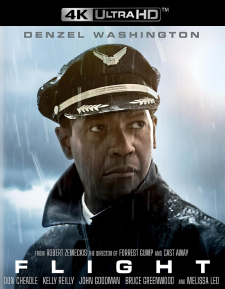
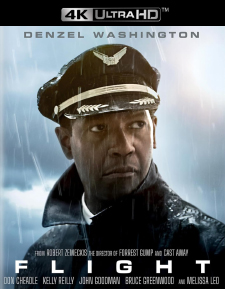
The Kino Lorber Studio Classics 2-Disc 4K Ultra HD release of Flight sits in a black Amaray case alongside a 1080p Blu-ray with an insert that features the film’s original theatrical poster artwork, which is also featured on the slipcover. The following extras are included on each disc:
DISC ONE: UHD
- Audio Commentary by Julie Kirgo and Peter Hankoff
DISC TWO: BD
- Audio Commentary by Julie Kirgo and Peter Hankoff
- Impact: Interview with Director Robert Zemeckis and Screenwriter John Gatins (HD – 28:57)
- Origins of Flight (HD – 10:30)
- The Making of Flight (HD – 11:32)
- Anatomy of a Plane Crash (HD – 7:47)
- Q&A Interview Highlights (SD – 14:18)
- Trailers:
- Flight (HD – 2:32)
- Mo’ Better Blues (SD – 2:42)
- The Bone Collector (HD – 2:29)
- The Manchurian Candidate (HD – 2:31)
- Inside Man (HD – 2:14)
- Turbulence (SD – 2:00)
Audio Commentary – The commentators differ in their feeling about flying—film historian and writer Julie Kirgo fears it, writer and filmmaker Peter Hankoff loves it. They say from the start that Flight is an A picture. It was a return to “straight-up filmmaking” for director Robert Zemeckis. He hadn’t made a dramatic film for ten years. Among his films: Used Cars, Back to the Future, Who Framed Roger Rabbit, Contact, Forrest Gump. Zemeckis is a pilot who had 1600 flight hours when he directed Flight. Nicole and Whip are at rock bottom when we meet them. Nicole knows how to handle herself and others but “she’s a mess,” as is Whip. He trips going up the steps to the plane, needs hits of oxygen. Whip is in denial about his condition. The commentators talk about the various special effects including the “rotisserie rig” which can rotate 360 degrees. Hydraulic equipment, carefully chosen camera angles, digital integration, and stunt actors complete the illusion that the plane is in distress. In the stairwell scene, the narrative takes a seven-minute detour as a gaunt cancer patient talks about his illness. Many felt this scene was too long, but Gatins had a close friend with cancer and it was important to him, so it remained in the film. Flight invokes God or spirituality. Its main character is analogous to a killer trying to get away with murder. Whip feels like a killer because some passengers and crew died in the crash. In the hearing scene, it looks as if his energy and confidence have drained out of him. Whip is experiencing his first honest internal feeling. Washington’s acting style is honest and sad.
Impact: Interview with Director Robert Zemeckis and Screenwriter John Gatins – Things lined up fairly quickly so Flight could be made. Zemeckis says he judges a script by its potential as a film. Gatins got the inspiration for the script from talking to an airline pilot on a plane trip. After reading the script, Denzel Washington was interested in doing the film. He met with Gatins to discuss the script and the character of Whip. Gatins wanted to direct but since a major actor was to star, the studio wanted a more experienced director. Zemeckis, Washington and Gatins worked on the script over many days. Gatins appreciated partnering with a director who knew writing, since Zemeckis had written screenplays, notably Back to the Future. All scenes had to be from Whip’s point of view. The film is about Whip’s journey. An analogy is made between Whip’s trying to control his life and trying to control the plane. Both are out of control. In aviation, most accidents are due to pilot error. Flying an inverted plane is possible. It happened with an Alaska Airlines aircraft. Building the fuselage that rotated was difficult. A key scene was shot in an actual hospital stairwell, which was difficult because of the smallness of the space. Zemeckis and his editor were having trouble editing until they realized that Washington was setting the rhythm for each scene through his performance. Paramount knew how it wanted to market the film and pictured Denzel Washington’s troubled face on the poster. In theaters, attendance grew steadily week by week.
Origins of Flight – John Gatins recalls how sitting on a plane next to a talkative pilot inspired him to write Flight. Director Robert Zemeckis loved the complexity of the main characters; both are damaged. The film is about a man coming to clarity about his life. Gatins based the film partly on demons he had to face in his own life. R-rated dramas weren’t in favor at the time. Zemeckis asserts that in a dramatic film, there’s also room for comedy and suspense. Suspense derives from what the characters are going to do. Denzel Washington received the script a year before filming. He was curious about Gatins’ process. The meeting in prison was added late in production.
The Making of Flight – This featurette contains behind-the-scenes footage of the making of Flight. Director Robert Zemeckis had done a series of motion-capture films. Flight was shot in 35 days. Actors Don Cheadle, Denzel Washington, and Kelly Reilly talk about their experiences on the film. An actual former drug addict coached Reilly on how to shoot drugs. Zemeckis’ directing style is easy going and collaborative. Actors in the film say he’s a successful all-around director. Washington and Brian Geraghty worked in flight simulators with a trainer to get the hang of operating the controls in a real airplane. “We get to play with the best toys and the best props at the highest level.”
Anatomy of a Plane Crash – The filmmakers based the story of Flight on several plane crash incidents. The gimbal that turns the set upside down with actors inside is shown. Only a section of the plane was in the gimbal because of the weight. A total weight (equipment and actors) of 30,000 pounds was turned upside down. Various rigs are shown in use.
Q&A Interview Highlights – John Horn of The Los Angeles Times moderates a panel with the cast and key crew members of Flight. They answer questions from the audience.
Flight is a captivating drama that traces the arc of a man coming to terms with himself as a result of a life-changing event. Though a plane crash is the catalyst that causes Whip to question his choices, it serves an exciting jumping-off point for an in-depth look at his journey. Though a bit too long at 138 minutes, the film nonetheless holds our attention. Director Robert Zemeckis has assembled a first-rate cast. Combining excellent performances, special effects magic, and a solid screenplay, Flight is a riveting character study.
- Dennis Seuling and Tim Salmons
(You can follow Tim on social media at these links: Twitter, Facebook, BlueSky, and Letterboxd. And be sure to subscribe to his YouTube channel here.)