
Eurocrypt of Christopher Lee Collection 2, The (Blu-ray Review)
Director
VariousRelease Date(s)
1959-1989 (July 26, 2022)Studio(s)
Various (Severin Films)- Film/Program Grade: See Below
- Video Grade: See Below
- Audio Grade: See Below
- Extras Grade: A+
- Overall Grade: A-

Review
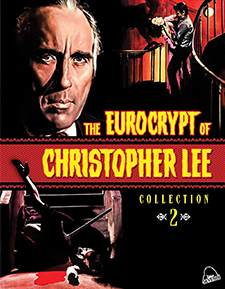
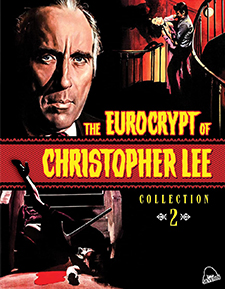
The great Sir Christopher Lee wasn’t one to adhere strictly to one type of genre in a single country. He traveled the world over playing a variety of roles on film and TV. As such, there’s a surplus of material, most of it readily available for viewing. However, some of his work, particularly what was made in Europe, hasn’t had quite as much reach. Rectifying that is Severin Films who previously cobbled together some of his work for The Eurocrypt of Christopher Lee Collection boxed set. They’ve returned for The Eurocrypt of Christopher Lee Collection 2, featuring six films total, most of which have rarely if ever been seen by Western audiences. Titles include Uncle Was a Vampire (1959), The Secret of the Red Orchid (1962), Dark Places (1974), Dracula and Son (1976), Murder Story (1989), and Mask of Murder (1988). Most of these selections have had next to no proper home video releases in the US, making this set an automatic must for fans of the late actor.
In 1959’s Uncle Was a Vampire (aka Tempi duri per i vampiri, Hard Times for Dracula, and My Uncle the Vampire), Baron Roderico (Lee) has arrived at a newly-opened hotel, which has been revamped (no pun intended) from a former family castle, previously owned by Osvaldo (Renato Rascel), who has subsequently been hired by the hotel as a put-upon bellhop. Unbeknownst to Osvaldo, Roderico is indeed a vampire, intent on drinking the blood of the lovely female guests, but also to pass on his vampiric powers to his pint-sized nephew. Meanwhile, Osvaldo is trying to shield his girlfriend (Antje Geerk) from his uncle, while also dealing with the overbearing hotel director (Carl Wery) and continuing to seek the advice of one of the hotel’s guests, the sleep-deprived Professor Stricker (Franco Scandurra). Hijinks ensue. Other cast members include Kai Fischer, Sylva Koscina, Lia Zoppelli, Rik Van Nutter, and Susanne Loret.
This is one of those horror comedies that’s firmly set in its time and place, and as such, much of its humor is lost on modern audiences outside of Europe. That said, there’s a pleasant charm to it that keeps you interested in where it’s going next. Renato Rascel keeps things very lively, and even Christopher Lee, who interestingly appeared in this film immediately after the success of Dracula aka Horror of Dracula, has a dry sensibility, mixed with his usual vampiric menace. What’s also fun is that the film’s plot operates on its own logic, not content with sticking to the usual vampire lore, and changing it where it suits the story and the humor. It’s also a nice-looking film with beautiful locations and lovely young people, but one’s enjoyment will depend entirely on their willingness to go along with its absurdities, as well as its lovable lead. Thankfully, there’s a seasoned Italian comedy director at the helm, Steno, so we’re in very good hands.
Uncle Was a Vampire was shot by cinematographer Marco Scarpelli on 35mm film with Ultrascope anamorphic lenses, the results of which were finished photochemically in Technicolor, and presented theatrically in the aspect ratio of 2.39:1. Severin debuts the uncut theatrical version of the film from a 2K scan of a dupe negative, encoded to a dual-layered BD-50 disc. It’s worth noting that an alternate TV version sourced from a broadcast tape master is included as an extra. The main presentation is unfortunately very unstable since it was printed directly into the dupe. Scratches, speckling, staining, and color imbalances pervade the presentation. The bitrate sits in the 35 top 40Mbps range, at the very least giving the presentation it’s best opportunity to look as good as it can. Colors range from decent to quite good in some instances, while blacks are often crushed with wavering levels of grain. It’s easy to complain about the quality, but since this is sourced from the only surviving film element, we must accept it for what it is. At most, it’s a step up from previous standard definition presentations.
Audio is included in Italian or partial English 2.0 mono DTS-HD Master Audio with optional subtitles in English for the Italian audio and English SDH for the English audio. The Italian audio definitely has more push for the score, while the English track is a little flatter. Sibilance and distortion are present on both tracks, as well. Neither of them are perfect, but they work well enough for the presentation at hand.
UNCLE WAS A VAMPIRE (FILM/VIDEO/AUDIO): C/C-/C+
In 1962’s The Secret of the Red Orchid (aka Das Rätsel der roten Orchidee and The Puzzle of the Red Orchid), Christopher Lee stars as Captain Allerman, an American FBI agent summoned to London in order to aid the local police in their fight against relocated Chicago gangsters who are blackmailing wealthy citizens and murdering the competition. Chief among Allerman’s suspects is “Pretty Boy” Steve (Klaus Kinski), concealed leader of one of the rival gangs posing as a simple merchant. However, many come under suspicion, and the beautiful Lilian (Marisa Bell) is put under Scotland Yard’s protection after receiving a threatening notice. Meanwhile, the nervous butler Parker (Eddi Arent) seeks constant work when his employers are bumped off, and Inspector Weston (Adrian Hoven) begins to take a liking to Lilian. Also among the cast are Pinkas Braun, Christiane Nielsen, Eric Pohlmann, and Wolfgang Büttner.
The Secret of the Red Orchid is part of the Rialto Films’ Edgar Wallace series of krimi productions, specifically based upon the novel When the Gangs Came to London (aka Scotland Yard’s Yankee Dick and The Gangsters Come to London). These films were highly popular in Germany and a great many of them were produced, though few got much of a release outside of their home country. Interestingly, but not surprisingly, Christopher Lee spoke fluent German, so much so that he was able to perform his role in German, though he was dubbed by someone else for the English language audio. The story itself is mostly an intriguing murder mystery, though with some futile comedic divergences, specifically those related to Eddi Arent’s character, which fall flat. Many red herrings are brought to the fore, making the film a sort of whodunit, but with a somewhat obvious solution for those paying close enough attention.
The Secret of the Red Orchid was shot by cinematographer Franz Xaver Lederle on 35mm black-and-white film with spherical lenses, which was finished photochemically, and presented theatrically in the aspect ratio of 1.66:1. Severin debuts the film on Blu-ray with a 2K scan of a dupe negative, encoded to a dual-layered BD-50 disc. Despite its source, it’s a lovely black-and-white presentation with solid grain levels and fine detail, with a bitrate that sits mostly between 25 and 35Mbps. It features very nice contrast with deep blacks and terrific grayscale, as well. There’s some some streaking here and there, as well as minor drops in quality during stock footage and optical transitions and titles, but it’s otherwise clean, stable, and quite satisfying.
Audio is included in German or English 2.0 mono DTS-HD Master Audio with optional subtitles in English for the German audio and English SDH for the English audio. Right up front, the English dub is fairly worthless. Not just because Christopher Lee is poorly dubbed, which certainly doesn’t help, but other performances are flat and uninteresting compared to the original German language track. It exhibits some mild hiss and sibilance, as does the English track, but the has more life to it. Neither are sonic wonders, but the German option is far more ideal.
THE SECRET OF THE RED ORCHID (FILM/VIDEO/AUDIO): B/A-/B-
In 1974’s Dark Places, Edward Foster (Robert Hardy) is the beneficiary of an old mansion out in the countryside, previously owned by Andrew Marr, a man who died in a mental institution. As Edward begins to spruce the home up, he slowly realizes that he’s being haunted by the house’s former residents. Meanwhile, his neighbors, Doctor Mandeville (Lee) and Sarah (Joan Crawford), are highly interested in a secret stash of money that’s supposedly hidden somewhere on the property, conspiring against Edward in order to find it. However, Edward has some secrets of his own, and as he begins hallucinating the lives of the previous owners, those secrets will come out in very deadly ways. Also among the cast is Herbert Lom, Jane Birkin, and Jean Marsh.
Director Don Sharp, who had worked with Christopher Lee on several films, including The Face of Fu Manchu and Rasputin the Mad Monk, does his level best to make an atmospheric and spooky haunted house thriller, but the worst aspect of Dark Places is that it’s such a dull film for great stretches of time. There are some interesting ideas, and if you’re familiar with films like Les Diaboliques, you’ll probably figure out where it’s all going eventually. Unfortunately, Robert Hardy, try as he might (even more so in the film’s final minutes), isn’t that intriguing to watch as he wanders around an empty house talking to ghosts. In many ways, Dark Places feels like an Amicus-produced Tales from the Crypt or Vault of Horror segment stretched out to 91 minutes, but with a more interesting and charismatic actor in the lead, it might have improved things. Sadly, Dark Places isn’t great and it doesn’t deliver what you would expect from it, which is a shame because these types of horror films are bread and butter for genre fans.
Dark Places was shot by cinematographer Ernest Steward on 35mm film with spherical lenses, which was finished photochemically, and presented theatrically in the aspect ratio of 1.85:1. Severin brings the film to Blu-ray from an uncut 4K scan of the internegative, encoded to a dual-layered BD-50 disc. It’s a very nice presentation of a film that’s had no representation on optical disc until this release, despite being a cable favorite in the 1980s. The presentation features prominent grain that resolves well enough, with a bitrate that sits primarily between 30 and 40Mbps. Mild speckling and instability are noticeable, but they’re not necessarily detriments to the overall quality. Mostly natural flesh tones are on display, as are deep blacks and good saturation, with strong greens, blues, and reds. It’s a dark film and this presentation certainly reflects that, but for never having appeared on DVD or Blu-ray before now, it’s more than welcome.
Audio is included in English and French 2.0 mono DTS-HD Master Audio with optional subtitles in English SDH. The French option has very little aural personality and the dubbing is very canned. The English track, even with its mild hiss, is certainly the better option. Quite obviously as well, since the film was initially released in English. It has also plenty of push for the dialogue and score, as well as sound effects.
DARK PLACES (FILM/VIDEO/AUDIO): C-/B+/B
In Dracula and Son (aka Dracula père et fils) from 1976, Lee portrays Count Ribovitz (otherwise billed and promoted as Dracula), who becomes a father to Ferdinand (Bernard Ménez). Driven from their home in Transylvania, they head for London, but wind up separated, each believing the other has met his demise. Ferdinand tries to make his way in the world but struggles with his appetite for human blood, not wanting to be a vampire at all. Count Ribovitz uses his vampiric sway to become a successful movie star, and both he and Ferdinand find each other at last. However, they soon become adversaries when they both fall for the beautiful Nicole (Marie-Hélène Breillat), who doesn’t believe in vampires, but will be made one if the Count has anything to say about it. Catherine Breillat and Bernard Alane are also in the cast.
If one’s only exposure to Dracula and Son is the 1979 U.S. version released by Quartet Films, then you really haven’t seen this film. That version is roundly considered atrocious as it was completely re-dubbed and re-cut to make it more overtly comedic. It was quite some time before the original French version, which is more of a clever satire, would make its way to the U.S. shores on home video, whereupon the film has slowly been re-evaluated. Clearly a parody of Hammer’s Gothic horror, as well as the history of vampires on film, Dracula and Son functions more with witty irony than pratfalls and mockery. Performances are generally great from everyone involved, even if the story does slow down in certain areas. It was also Lee’s final bow as “Dracula” before moving on to other phases of his long career.
Dracula and Son was shot by cinematographer Alain Levent on 35mm film, which was finished photochemically, and presented theatrically in the aspect ratio of 1.66:1. Severin debuts the director’s cut of the film for the first time in the U.S., as well as the original theatrical version, both of which were restored in 4K from the original camera negative, and encoded to separate dual-layered BD-50 discs. This is a marvelous-looking upgrade of both versions of the film with well-resolved grain and high levels of detail not seen in previous presentations. Bitrates sit in the 30-40Mbps range, but everything appears clean and stable with lovely saturation and good contrast. Blacks are deep and flesh tones are natural, even when presented as pallid.
Audio is included in French and English 2.0 mono DTS-HD Master Audio with optional subtitles in English for the French track and English SDH for the English track. The French track offers a much fuller experience as the English track has absolutely no bottom end. The dubbing is also more canned on the English track. However, both are very clean with no other issues. Those worried about which to choose as far as performances are concerned need not worry when it comes to Christopher Lee, who dubs himself on both tracks. Other performances on the English track, especially as it pertains to whomever dubs for Bernard Ménez, leave more to be desired. In essence, the French track is the more preferable choice overall.
DRACULA AND SON (FILM/VIDEO/AUDIO): B-/A/A-
In 1989’s Murder Story, young college student and aspiring novelist Tony (Alexis Denisof) is excited when his favorite horror author, Willard Hope (Christopher Lee), will be appearing locally at a book signing. Upon their meeting, the two strike up a friendship when Tony reveals that he has been following in Hope’s footsteps, using the method of trimming stories from newspapers to build stories around. Tony inadvertently stumbles upon a secret murder plot after connecting the dots using his clipped articles, which intrigues Hope. Meanwhile, a pair government assassins, led by Corrigan (Bruce Boa), are paying close attention, and they’ll do whatever it takes to keep classified information from leaking, including murder. Other cast members include Stacia Burton, Kate Harper, William Brand, Marie Stillin, Garrick Hagon, Jeff Harding, and Kieron Jecchinis.
Co-writers and co-directors Eddie Arno and Markus Innocenti, who up until this point had been directing music videos for the likes of Bob Dylan and the Eurythmics, developed Murder Story as their first feature, which was filmed in the Netherlands, Holland specifically, for very little money and almost no distribution afterwards. The film mostly hit cable and home video, but was more or less forgotten except by long-time fans of Christopher Lee. According to the producer, his fee was the biggest part of the film’s budget, but he still delivered a fine performance and continued his reputation for staunch professionalism. The film itself is a mixed bag, in all honesty. Lee is always worth seeing, but performances are fairly lackluster and the plot is deadly slow in getting underway, going off on tangents as Tony navigates a relationship with his new girlfriend, deals with his overbearing mother, and rides motorcycles with his friends. It’s a lazy afternoon sort of movie, one that doesn’t require you to think all that much, but it’s not much more than that.
Murder Story was shot by cinematographer Wayne Bickerton on 35mm film with spherical lenses, which was finished photochemically, and presented theatrically in the aspect ratio of 1.85:1. Severin brings the film to Blu-ray with a 4K scan of the original camera negative, encoded to a dual-layered BD-50 disc. Severin warns us at the outset that the negative was stored in less than ideal conditions, leaving behind some “deterioration” in places (and incorrectly referring to this as a 2K scan). This is limited to random shots where the negative appears thinner with mild scratches and speckling. None of it is prominent or even frequent as the majority of the presentation is quite good. Bitrates sit between 30 and 40Mbps with grain that resolves well enough, nice flesh tones, excellent color, and very good contrast. The image is also stable, with no other issues to speak of.
Audio is included in English 2.0 mono DTS-HD Master Audio with optional subtitles in English SDH. It’s a clean if unremarkable soundtrack with plenty of support for the various elements, including dialogue and score. Sound effects are sometimes limited, but that’s mostly chalked up to the production itself and not a knock on the track’s quality. Footsteps and the sounds of water, for instance, can be very thin.
MURDER STORY (FILM/VIDEO/AUDIO): C/B+/B
In 1988’s Mask of Murder (aka The Investigator), Superintendent Bob McLaine (Rod Taylor) has hunted down and shot a notorious masked killer who has been slitting the throats of local young women. The Chief Superintendent (Lee) is wounded during the apprehension and hospitalized, leaving McLaine to clean things up with his partner, Superintendent Ray Cooper (Sam Cook). Bob, meanwhile, has been having trouble sleeping, as well as marital issues, and his wife Marianne (Valerie Perrine) decides to take a holiday without him. However, Bob doesn’t realize that she’s actually having an affair with Ray, and as he continues his police work with a constant lack of sleep, a similar pattern of murders begins to occur. Other cast members include Terrence Hardiman, Christine McKenna, Cyd Hayman, Heinz Hopf, and Hjördis Petterson.
A Canadian-produced giallo through and through, Mask of Murder is a very slow burn thriller that has a very obvious conclusion, which is so obvious that it’s actually startling when it actually occurs. It does tend to drag in places, but performances are good, particularly from Rod Taylor, while Christopher Lee gets little screen time. However, when he does get to participate, he’s used in valuable ways, including being the main discoverer of the identity of the second killer. Directed by Arne Mattsson, who mostly made films in Sweden, the film’s title was changed from The Mask to Mask of Murder before its release, and some newspapers even referred to it as Mask for Murder. It didn’t get any theatrical distribution and went straight to video, which is unfortunate since a widescreen copy of the film doesn’t exist to be seen anywhere.
Mask of Murder was shot by cinematographer Tomislav Pinter on 35mm film with spherical lenses, which was finished photochemically, and presented theatrically in the aspect ratio of 1.85:1. Appearing as an extra on the same disc as Murder Story, Mask of Murder has been sourced from the best existing master in standard definition, with an aspect ratio of 1.33:1. Harsh judgments of the quality of this presentation should be left at the door. It’s included as a bonus film and should be treated as such since any film elements are seemingly missing in action. It’s a very watchable copy that’s not quite as murky as some VHS releases tended to be back in the day, especially horror films with low levels of light. Color and contrast are decent for what it is, and we should be thankful that Severin has bothered to include it at all. One hopes that the camera negative or an interpositive, even a print, might be unearthed someday.
Audio is included in English 2.0 mono DTS-HD Master Audio with optional subtitles in English SDH. Severin appears to have alleviated any tape-sourced audio issues such as hiss or buzzing, which is good since the audio doesn’t lend itself to the format all that much. Dialogue is mostly discernible, while score and sound effects have mild push to them.
MASK OF MURDER (FILM/VIDEO/AUDIO): C+/D+/C
The Severin Films 7-Disc Blu-ray release of The Eurocrypt of Christopher Lee Collection 2 houses five black Amaray cases, one containing a soundtrack listing insert for Dracula and Son. Also included is a 100-page booklet featuring the essay Christopher Lee: A Career in Snapshots by Jonathan Rigby, along with various photos and ephemera, and a list of credits and acknowledgments. Everything is housed in a deluxe hardbox fliptop package like the first collection. The follow extras are included on each disc for each film:
DISC ONE: UNCLE WAS A VAMPIRE
- Commedia Dracula All’Italiana (SD – 12:35)
- Alternate Cut from Italian Broadcast Master (SD – 97:13)
- Alternate Cut Audio Commentary with Jonathan Rigby and Kevin Lyons (SD – 97:13)
- Easter Egg (SD – 2:05)
In Commedia Dracula All’Italiana, European film scholar and professor of film studies at the University of Edinburgh, Dr. Pasquale Iannone, details the careers of director Steno and Renato Rascel, gives a history of parody films in Italy, and provides a rundown of various aspects of the film. Also included is the aforementioned alternate cut of the film from Italian broadcast master that’s a few minutes shorter, but comes armed with a fantastic audio commentary by Christopher Lee biographer Jonathan Rigby and Hammer Historian Kevin Lyons. They humorously and expertly guide us through the film, delving into the careers of those involved, and give us some insight into Lee’s participation. Included as an Easter egg, which can be found by pressing left in the Bonus menu to reveal a partial cutout of one the film’s posters, is an alternate set of opening titles in English taken from a VHS source.
DISC TWO: THE SECRET OF THE RED ORCHID
- Audio Commentary with Nathaniel Thompson and Troy Howarth
- Audio Commentary with Kim Newman and Barry Forshaw
- German Trailer (HD – 3:05)
The first commentary features Mondo Digital’s Nathaniel Thompson and author Troy Howarth. They explore the actors and filmmakers involved with the film, as well as the krimi genre and its many tributaries into gialli and crime thrillers, before delving into the state of Christopher Lee’s career at this point in time. The second features film critics and authors Kim Newman and Barry Forshaw and it’s more of an exploration of Edgar Wallace and his novels before offering a more critical analysis of the film, while also speaking about the cast and crew. As pointed out by Thompson and Howarth, these appear to be the first English language audio commentaries for home video releases of krimi films. Last is the film’s German trailer.
Not included from the Region 2 DVD release from Tobis in Germany is an audio commentary by Joachim Kramp, an interview with actress Eva Edner, and a photo gallery.
DISC THREE: DARK PLACES
- Audio Commentary with Nathaniel Thompson and Troy Howarth
- Christopher Lee: The Cadogan Conversations (HD – 23:45)
- US Teaser Trailer (HD – :54)
- Brazilian TV Spot (HD – 1:23)
Nathaniel Thompson and Troy Howarth return once more to perform audio commentary duties. They are very candid but respectful of their opinions of the film, which are not all that positive. They nonetheless cover the usual items, including the careers of the main cast and crew, while also highlighting where Christopher Lee was at this stage in his career. In The Cadogan Conversations, author and film historian Jonathan Rigby returns to discuss his upbringing as a horror fan and his love of Christopher Lee as a performer, which eventually led to his writing of Christopher Lee: The Authorised Screen History, of which he recounts his work and interactions with Lee in creating it. Last is the film’s US teaser trailer and a Brazilian TV spot (the latter being more of a trailer).
Not included from the 2023 Blu-ray release from Nucleus Films in the UK is an audio commentary with Jonathan Rigby and Kevin Lyons, Looking Into Dark Places with Jonathan Rigby, an image gallery, and a Don Sharp trailer reel.
DISC FOUR: DRACULA AND SON (DIRECTOR’S CUT)
- Audio Commentary with Jonathan Rigby and Kevin Lyons
- Audio Commentary with Kat Ellinger
- Let the Son Shine In with Bernard Ménez (HD – 18:51)
- Archival French TV Interview with Christopher Lee (Upscaled SD – 1:51)
- The Molinaro Tapes: Conversations Between Édouard Molinaro and Fréderic Albert Levy (HD – 14:48)
- Who Was Claude Klotz? (HD – 7:09)
- Archival Interview with Claude Klotz (Upscaled SD – 1:49)
- Teaser Trailer (HD – 2:23)
DISC FIVE: DRACULA AND SON (U.S. VERSION)
- U.S. Version (HD – 77:54)
- German Credit Sequences (HD – 2:00)
- TV Spot (HD – :24)
DISC SIX: DRACULA AND SON (CD SOUNDTRACK)
- Dracula fils (2:25)
- Dracula père (2:12)
- La diligence (1:44)
- Herminie et le Comte Dracula (1:13)
- L’aube arrive... (2:29)
- Le flacon de sang (2:25)
- Herminie mord le Comte (2:09)
- Dracula danse (1:11)
- Hai la vale! (1:46)
- Devant la griffe du château (1:38)
- Ferdinand â l’abattoir (:52)
- Dracula et Ferdinand adolescent (1:42)
- Amour douloureux (1:37)
- Dracula sort du cercueil (1:55)
- Rencontre père et fils (1:08)
- Nicole et Ferdinand (1:25)
- Les cendres (2:30)
The first audio commentary features Jonathan Rigby and Hammer historian Kevin Lyons once again, the latter of whom maintains the web site The Encyclopedia of Fantastic Film and Television. It’s a standard cast and crew recollection sort of track, though both men bring their knowledge of the film’s production and the genre to the forefront expertly. The second commentary features Kat Ellinger, author of Daughters of Darkness. She delves more into the Gothic horror genre, delving into the idea of the film being a satire, giving an outright dismissal of the US re-cut (rightly so), and covering much of Christopher Lee’s career and his uneasy relationship with having portrayed Dracula multiple times.
Let the Son Shine In features an interview with actor Bernard Ménez who discusses becoming a stage actor and transitioning into a film star, his working relationships with Édouard Molinaro and Christopher Lee, his thoughts on his character and the story, and how proud he is of the film. The brief Archival French TV Interview with Christopher Lee also mixes in some behind-the-scenes footage as the actor speaks fluent French to the camera to discuss the film while having a meal. The Molinaro Tapes contains an archival 1979 audio interview with director Édouard Molinaro by Fréderic Albert Levy in which he discusses the genesis of the project, aspects of the film that he appreciates versus others that he doesn’t, his appreciation for the actors and their performances, and his ultimate feelings about the film, as well as his other films. Interestingly, they show a clip from the US trailer, but do not include the full version in the extras.
Who Was Claude Klotz? interviews filmmaker Patrice Leconte who worked with Klotz on Le Mari de la coiffeuse aka The Hairdresser’s Husband, L’homme du train aka The Man on the Train, and Felix and Lola aka Félix et Lola. He briefly discusses the author and screenwriter and their working relationship. Last is another brief archival interview, but with Claude Klotz at a 1976 screening of the film in Marseille, discussing the film and its characters.
Also included is the U.S. re-cut version, which is good for archival purposes, but it’s awful compared to the original version (if I haven’t made that clear enough yet, that is). Then there’s the teaser trailer in English, a set of German opening and closing credit sequences, and a US TV spot. Last is a 17-track CD soundtrack of Vladimir Cosma’s score for the film.
DISC SEVEN: MURDER STORY
- Audio Commentary with Eddie Arno, Markus Innocenti, and David Gregory
- A British Producer in Holland (HD – 14:00)
- Mask of Murder (Upscaled SD – 89:11)
- Trailer (HD – 1:55)
The audio commentary features co-writers and co-directors Eddie Arno and Markus Innocenti, moderated by David Gregory. David interjects occasionally to ask questions, but he doesn’t necessarily need to as the two men (Markus being piped in via Skype) keep the conversation rolling along smoothly, moving from subject to subject with ease as two old friends eager to talk about their pasts. They discuss their careers in music videos and designing stage shows for musical acts before going into detail about the film’s production, as well as its cast and crew, including Christopher Lee. A British Producer in Holland speaks to producer Tom Reeve about living in Holland, putting the production money together, casting the film, meeting Christopher Lee and working with him on the film, being impressed by Eddie Arno and Markus Innocenti, the trouble with the film’s distribution, and his appreciation of Lee after the film wrapped. Last is the previously-discussed feature Mask of Murder and a digitally re-created trailer for Murder Story. Unfortunately, there are no extras devoted to Mask of Murder.
Since I’m a little late to the ballgame on this one, chances are good that if you’re reading this, you probably already own The Eurocrypt of Christopher Lee Collection 2; but since I wanted to cover Collection 3, I felt compelled to give the second volume my full attention. The assortment of films in this release is perhaps more eccentric and less straight-horror based, but since Christopher Lee appeared in a number of different productions over the course of his life, it’s wonderful that these films are getting this kind of attention. It’s another wonderful release and belongs on every Christopher Lee fan’s shelf, along with the other two volumes. Highly recommended.
- Tim Salmons
(You can follow Tim on social media at these links: Twitter, Facebook, BlueSky, and Letterboxd. And be sure to subscribe to his YouTube channel here.)