
Counsellor, The (1973) (Blu-ray Review)
Director
Alberto De MartinoRelease Date(s)
1973 (September 22, 2026)Studio(s)
Capitolina Produzioni Cinematografiche/Star Films S.A. (Kino Lorber Studio Classics)- Film/Program Grade: C+
- Video Grade: A
- Audio Grade: B+
- Extras Grade: B

Review
Breaking box office records and putting Marlon Brando back among bankable stars, The Godfather was an adaptation of Mario Puzo’s crime novel with a great script and impeccable casting. The film inspired subsequent pictures such as Goodfellas, Once Upon a Time in America, Casino and A Bronx Tale. It also inspired a lesser-known Italian film, 1973’s The Counsellor (also known as Il consigliere), which deals with an aging crime boss, loyalty, vengeance, and murder.
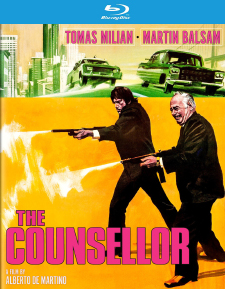
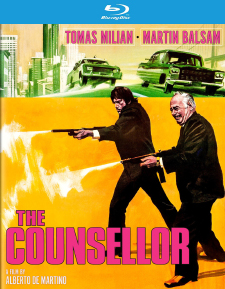
Convicted of bribing a juror, Thomas Accardo (Tomas Milian), a mob lawyer, is released from a New Mexico prison. Counsellor to San Francisco-based mob boss Don Antonio (Martin Balsam), Accardo is now disbarred and has to leave the Mafia and find some kind of legitimate job. Don Antonio tries to persuade him not to leave the Family, since this is frowned upon in crime circles. But Thomas has made up his mind, and the Don gives his blessing.
One of Don Antonio’s men, Garofalo (Francisco Rabal), betrays him by joining forces with the Spezzanos, a rival crime family, to take over the Don’s businesses and kill Accardo. Narrowly escaping Garofalo’s assassination attempt, the counsellor reconnects with Don Antonio to help him take down his enemies. From this point, the film becomes mostly a cat-and-mouse chase and shoot-out flick.
The Counsellor was made when Italy was undergoing an epidemic of real-life mob criminality and violence, and the genre had exploded after the success of American crime dramas such as Dirty Harry (1971) and The Godfather (1972). The Counsellor follows a template similar to The Godfather with its emphasis on family loyalty, codes of honor, and inter-family wars. It was shot quickly to capitalize on the success of The Godfather.
Filmed in San Francisco, New Mexico and Sicily, The Counsellor has an international flavor with impressive production value and excellent photography. Director Alberto De Martino makes excellent use of the widescreen lens, giving the film an epic look with panoramic views of the Golden Gate Bridge, streets of Albuquerque, and the hills of Sicily.
Much of the screen time is devoted to the relationship of Thomas and Don Antonio, almost a father-son bond. The chemistry between Balsam and Milian makes their characters’ actions believable.
Balsam is best known for supporting roles, so seeing him as the film’s star is unusual. He appeared in many A-list films, won a Best Supporting Actor Oscar, and had a lucrative career playing secondary or tertiary leads. He also made several pictures in Italy. Perhaps his best known role is the doomed private detective in Hitchcock’s Psycho.
Though it takes a while to get used to him as a crime boss, Balsam does bring an old world ethos to the role. Don Antonio is of an era when honor and loyalty were important. He must deal with a younger faction that ignores these values if they become inconvenient. Like Brando in The Godfather, Balsam delivers a calm and thoughtful don, never given to outbursts of anger because his power is undeniable. Yet his best efforts never fully convince as a crime boss. He comes off more as a middle-class real estate broker or salesman. In a climactic scene, thrust into the role of action hero, he looks uncomfortable wielding a machine gun and mowing down men like shooting gallery ducks.
Tomas Milian, a bigger star in Europe than in the U.S., is the catalyst of the story. Intelligent and good-looking, with eyes that convey warmth or defiance depending on the scene, his Thomas shows a sensitive side that many of his fellow criminals lack. We admire his wish to go straight and understand why he abandons it when his mentor and father figure is threatened. During his career, Milian played an array of colorful characters. It’s interesting to see how effectively he handles a more subdued yet intriguing character in The Counsellor.
Trivia fans might be interested to spot John Anderson in a few scenes as Don Vito Albanese. Like Balsam, he appeared in Psycho. He played the used car salesman who commented that Marion’s (Janet Leigh) haste in buying a car was the first time the customer high-pressured the salesman.
The Counsellor was shot by directors of photography Joe D’Amato and Rafael Pacheco on 35mm film in the Techniscope process with anamorphic lenses, processed by Telecolor, Rome, and presented in the aspect ratio of 2.35:1. The 4K scan of the 35mm original camera negative infuses new life into the film, with vibrant color and well delineated detail. Surface imperfections such as scratches, cue marks, emulsion clouding and embedded dirt specks have been eliminated. For a crime drama, the film is oddly bright with few moody, shadowy scenes. The film plays out mostly in bright daylight. The few night scenes have a bluish tint.
There are two soundtracks, the original Italian and dubbed-English versions, in 2.0 mono DTS-HD Master Audio. English subtitles are shown on screen in the Italian version. Martin Balsam did his own dubbing. The other actors were dubbed by English-speaking actors, not always convincingly, which is distracting and takes you out of the movie. The score by Riz Ortolani is somewhat laid-back for a crime drama, never amping the tempo enough to match the action sequences. In quiet scenes, the score is fine. Sound effects include cars racing and skidding and lots of gunfire.
Bonus materials on the Blu-ray release from Kino Lorber Studio Classics include the following:
- Audio Commentary by Steve Mitchell and Troy Howarth
- Video Essay by William Webb (6:17)
- Trailers:
- The Counsellor (4:13)
- Blazing Magnum (3:22)
- Weapons of Death (3:30)
- The Taking of Pelham One Two Three (2:33)
- Violent City (3:54)
Audio Commentary – Film historians Steve Mitchell and Troy Howarth describe The Counsellor as an “international crime film.” They’re surprised to see that Emilio Ruiz del Rio, a special effects expert and an important presence in Italian cinema, is credited as production designer. Outdoor scenes are reminiscent of Bullitt and Streets of San Francisco. Director Alberto De Martino adapted to the San Francisco environment really well. Francisco Rabal was almost cast by William Friedkin as Chernier (Frog 1) in The French Connection. The commentators draw attention to Rabal’s obvious hairpiece, noting that many actors in the 1970s wore hair pieces that varied in quality. The Counsellor is well-cast, with American, Italian, and Spanish actors. Many shots are “touristy” to show picturesque places. The film has production value and gloss. De Martino exploits locations effectively; he’s great with outdoor settings. He understands cinematic space and cinematic shorthand and grammar, often filming in Cinemascope. Because of his use of widescreen, “you’re never confused; you’re always grounded.” He makes use of America’s wide streets and big cars. De Martino uses the widescreen to tell the story in an emotional way. Widescreen became popular in the 1950s to compete with TV. Pan-and-scan compositions made to accommodate older TVs leave out much of the original image. With large, widescreen TVs and Blu-ray releases, pan-and-scan films are hardly seen these days. In the 1980s, the rise of multiple TV channels in Europe expanded home entertainment offerings and attendance at the movies plummeted. Movie production and distribution dwindled with lots of down time between productions. TV formed a stranglehold on the industry. Directors had to compromise by working on lesser films, but De Martino retired rather than go down that path. His career spanned 25 years, his films varying in quality. Tomas Milian was a huge star in Europe at the time. Martin Balsam, essentially a character actor, has a substantial role and is top billed. Balsam referred to playing supporting roles as “the perfect career for an actor.” He gets to “dip his toe” into stardom in The Counsellor. He can be both sympathetic and menacing. He felt “the work always comes first.” Balsam made ten films in Italy as well as many A-list American films. He won an Oscar for A Thousand Clowns. He and Milian have chemistry. You believe their characters care for each other. Sacheen Littlefeather is pointed out in a small role. She turned down the Best Actor Oscar on Marlon Brando’s behalf at the Academy Awards in 1973. Some scenes in The Counsellor were filmed in an actual prison in New Mexico. In conclusion, the commentators say, “This is a solid picture. If you want to watch a crime movie, this is a good one to watch.”
Video Essay by William Webb – Narrator William Webb talks about the popularity of Mafia films of the period that deal with corruption, violence, politics, and tension among crime families. The film is also known as Il consigliere and Counsellor at Crime. The film deals with Mafia-aligned lawyers. It was filmed quickly to take advantage of interest in the Mafia inspired by The Godfather. The film retains a cool sense of style and camera work. Though set primarily in the U.S., The Counsellor is “very much an Italian film in style and dramatic concerns.” The old-school approach to crime is represented by Don Antonio. Garofalo represents the new style—brutal, unexpected, and treacherous. The older version is more honorable, less frightening than the newer version. In America, Garofalo has the upper hand, but in Italy Don Antonio’s traditions win out.
If you can get past the fact that The Counsellor is derivative of its more-famous predecessor you will appreciate that the performances are good, with Balsam essaying a rare starring role. Much of the supporting cast is composed of Italian actors with a few Americans in the mix. Director De Martino gives the film a big-picture look with his skillful use of Cinemascope and preference for multiple set-ups rather than the typical 1970s choice of the zoom lens to save time and money. Action scenes are well staged, though the “movie blood” looks nothing like the real thing. It’s hard not to be distracted by fashions of the era, especially bell-bottom pants and Milian’s long hair. Martin Balsam as a feared Don is hard to believe. It’s a stretch to accept him as a mafioso who’s risen through the ranks to become the head of a feared crime family. It takes a while to know who’s who among the characters, and some are underdeveloped. “Rip-off” might be too harsh a designation for The Counsellor, but you will recognize familiar characters, story points and themes from earlier pictures. The plot is rudimentary, mostly an excuse for car chases, shoot-outs and murders.
- Dennis Seuling