
Corruption (1963) (Blu-ray Review)
Director
Mauro BologniniRelease Date(s)
1963 (September 15, 2026)Studio(s)
Arco Film/Burgundia Film/SOPAC/Parus Films (Radiance Films)- Film/Program Grade: B
- Video Grade: A
- Audio Grade: A-
- Extras Grade: B+

Review

One of the key elements of being an informed cinema fan is to also be a fan of history. You’re missing a lot if you go into films completely blind. It’s something that has kept me from being an Italian cinema fan. I generally enjoy what I’ve seen that has come out of Italy, but watching Italian movies ends up taking too much time for me because I end up having to do so much homework trying to understand everything. So, for the most part, aside from the genre kings like Leone, Argento and Bava and the Criterion masters like Fellini, De Sica and Antonioni—I haven’t really watched much Italian cinema except for a few gems here and there. The reason for the homework is, in my opinion, Italian cinema, more than most, is so closely tied to the current (or the “at the time”) sociopolitical environment particular to the country. What is going on “right now” is what the film addresses, and Italy has a very turbulent history and Italian filmmakers are very good at commenting upon it. Corruption is a very good example of that dilemma for me.
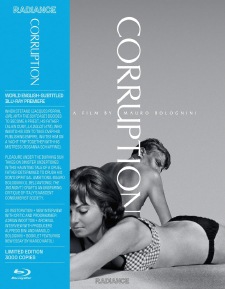
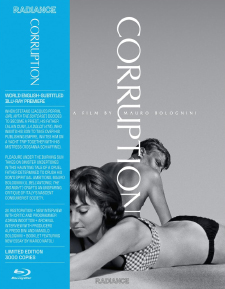
On its face, Corruption is a very simple film that, in these times, in these United States, could be viewed as my favorite current slang: cringe. A young man, Stefano (multi-Academy Award winning producer Jacques Perrin) graduates from boarding school, seemingly having already made the decision to join the clergy. Stefano goes home to his father Leonardo (the always wonderful Alain Cuny), a successful publisher, and lets him know that he will not be following in his footsteps and taking over the business. Leonardo is none-to-pleased at this and suggests, after a frightful wake-up in the middle of the night, that they take a yacht cruise so they can discuss this life altering plan more intimately. Much to Stefano’s great dissatisfaction, a beautiful girl, Adriana (Rosanna Schiaffino), who Stefano assumes to be his father’s mistress joins father and son on the cruise. Many people read this as the cringe part of the film: the raw egotism of Leonardo taking his current lover on this trip originally meant for them to have a face-to-face discussion about Stefano’s future. But things aren’t as simple as that, in my mind at least. Over the course of the cruise Adriana aggressively flirts with Stefano. Stefano fights against this, partly because of his plans for his future and partly because he doesn’t want to upset his father by falling into bed with his father’s mistress. But the title of the film is the thing here—Corruption. Adriana’s presence on the yacht is solely and explicitly to tempt Stefano away from making a rash decision—placed there and paid for by Leonardo. Adriana is a sex worker, and sure, she may have had some fun with Leonardo, but she’s not HIS girl. She’s her own. And she’s there to corrupt Stefano, plain and simple. The simplicity of this “love triangle” deepens when you consider exactly where Italy was in 1963.
After WWII, Italy had a huge economic growth period. From 1950 to 1963 they made their biggest leaps. This period was known as Italy’s Economic Miracle—integrating into the European economic machine, expanding manufacturing exponentially. Many Italian exports dominated the market. But 1963 saw the beginning of the slowdown that went on until the 1970s. When you look at the film through the eyes of young filmmakers in the middle of that history happening around them, telling their story of a jaded young man turning his back on what he sees as a soulless capitalistic endeavor, wanting more from the world and a father blindly rolling forward, not caring about anything or anyone but his self and his son and a young woman basking in the freedoms her beauty brings her in this modern day; when all the damage has been done between father and son and a young man weeps as he watches a group of young people dance in joyless syncopation, you can see Italy 1963 in movie form, and it seems less cringe and illustrates exactly why I avoid Italian cinema like a brussels sprout pancake. Maybe I’ll devote more time to Italy when I retire and have more time.
Corruption is presented on Blu-ray with a 1080p transfer in 1.85:1 and looks pretty good. There are some moments at the start where Bolognini used some stock footage of a monastery, and the footage doesn’t match and showcases some damage not carried over into the erst of the film. Cinematographer Leonida Barboni’s lush black and white photography is represented well. Sound is a LPCM mono track in original Italian with nice readable subtitles. Being mono there is no expectation of a playful sound field, but it sounds fine. Extras are somewhat light, but informative. First up is a visual essay by Adrian Wootton that gives some context to the sociopolitical information I mentioned above and background on Bolognini and his place in Italian cinema. There’s also an archival interview with producer Alfredo Bini and production manager and brother to Mauro—Manolo Bolognini. It’s a fun piece shot later in these gentlemen’s lives talking about the film, Mauro, and Italian cinema in general. Bini is the type of guy to take full credit for inventing the bikini and his charm allows for it, even if you know it was invented 20 years before this film was shot. Inside the packaging is a nice essay by Marco Natoli which goes a little more into the Italian sociopolitical context and a reversible sleeve.
Italian Cinema isn’t something I go out of my way to watch, but I enjoy what I get to see when special boutiques like Radiance spend the time and energy to restore and release them. It may piss me off that I have to go down rabbit holes, but getting to see gems like Corruption is worth the extra work.
- Todd Doogan