
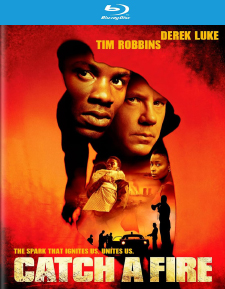
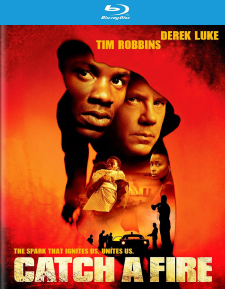
Catch a Fire (Blu-ray Review)
Director
Phillip NoyceRelease Date(s)
2006 (September 29, 2026)Studio(s)
StudioCanal/Working Title Films/Mirange Enterprises/Focus Features (Kino Lorber Studio Classics)- Film/Program Grade: A-
- Video Grade: A
- Audio Grade: A
- Extras Grade: B

Review
Apartheid, the Afrikaans word for separateness, was South Africa’s policy of racial segregation and white supremacy. It was codified into increasingly repressive laws beginning in 1948 and didn’t end until 1994 after years of internal and international resistance. Films dealing with this institution include Cry Freedom, Goodbye Bafana and Escape from Pretoria. In Catch a Fire, based on a true story, an apolitical Black oil refinery worker finds himself targeted as a terrorist after a sabotage attack on the factory.
South African Patrick Chamusso (Derek Luke) has a good job as foreman at the Secunda oil refinery that allows him to support his wife and children, own a car, and survive in the oppressiveness of South African white supremacist policy. After members of an anti-apartheid group blow up parts of the refinery, suspicion falls on the innocent Patrick and he’s abruptly arrested and tortured under the supervision of Nic Vos (Tim Robbins), a major official in the country’s homeland security division. Patrick endures the abuse, but after his wife (Bonnie Henna) is also picked up, beaten and interrogated, he resolves to become part of a violent resistance organization.
There’s a bit of Les Miserables going on with Vos as the Javert character and Patrick as Valjean. Vos is convinced that Patrick, because of his access to areas of the refinery, is a collaborator in the bombing. He oversees, but never takes part in, the physical torture of Patrick. Vos’ skill is patiently wearing down his subject, moving from brutality to humane treatment. When Patrick lies bound and bleeding in his cell, for instance, Vos takes him out to have lunch with Mrs. Vos and the children. Though Vos’ wife and kids look uncomfortable, they put up with this psychological plan to throw Patrick off balance in the hope that it will lead him to reveal the identity of his supposed cohorts.
Director Philip Noyce presents the everyday tensions under which Black South Africans had to live under apartheid. In one sequence, Patrick is driving his family when he’s stopped. A white police officer asks for his identity papers, which are required to be carried by every Black citizen. He’s forced to exit the car while the trunk is checked and he’s pushed roughly to the ground and searched. Such indignities are not uncommon. His family remains silent in the car and Patrick dutifully obeys the cop, knowing that any objection will likely land him in jail.
Neither of the main characters is purely good or purely evil. Patrick becomes a freedom-fighter in a nation that treats him and his fellow Blacks as inferiors, but not until he’s unjustly jailed and tortured and so is his wife. Vos genuinely feels white South Africans, far outnumbered by Blacks, must be diligent to protect his own family as well as those of his fellow white Afrikaaners. At the same time, he’s committed to perpetuating the brutal subjugation of the Blacks.
Luke elicits sympathy for Patrick from the outset when he’s mistaken for a terrorist. He can do nothing other than insist he’s innocent, but he’s denied a jury trial. Vos prioritizes expedience over justice. Luke immerses himself so completely in the character of Patrick that we see him evolve from a gentle, apolitical family man to a deeply anguished victim of torture and eventually a determined, righteous revolutionary. Luke exhibits an impressive emotional range. When he’s accused of being a terrorist, his nightmare begins.
When Patrick sees his wife after she’s been beaten, something in him snaps and his usual soft-spoken manner explodes into outrage. Fraught with anger, the inability to protect his wife, and a fierce desire for vengeance, he’s radicalized. Willing to live in an oppressive system as long as he’s relatively safe, he knows how being subservient will only keep that system in place. Luke plays Patrick with confidence when he’s at work. He knows his job and is a good foreman. When confronted by a white cop, his demeanor is far different—quiet, eyes cast downward, answering questions with “Boss.” Luke is up to the challenges of a complex role.
Robbins plays Vos with such subtlety that we might begin to imagine he has some human feeling for the downtrodden Blacks. A composite of different individuals that the real Patrick encountered while under arrest, Vos is skilled at interrogation, using psychological means to draw out information. Robbins is deadly serious when Vos checks out a recent bombing site, but more relaxed when we see him at home, with family. His face is cold and humorless, but we know he’s thinking, assessing, putting together bits of information. Director Noyce shows Robbins frequently in close-up, since he doesn’t have a lot of dialogue. The slight narrowing of his blue eyes shows the iciness behind them.
Catch a Fire is at its best when showing the conflicts at the heart of apartheid. A memorable sequence cuts between two rituals: the awarding of a medal to Vos and the burial of murdered resistance fighters in Mozambique. The film has a documentary-like narrative that chronicles actual events in Patrick’s life. At the end of the film, the real Patrick Chamusso is shown with an update on his life after the events shown in the film. An epilogue tells about South Africa’s process of reconciliation after apartheid ended and the seat of governmental power was reversed.
Catch a Fire was shot by directors of photography Ron Fortunato and Garry Phillips on Super 16mm and Super 35mm film (the final scene was captured on video) with spherical lenses. The results were finished as a 2K Digital Intermediate with an aspect ratio of 2.35:1. On the Blu-ray, clarity and contrast are excellent. Color palette is muted in views of the bleak countryside where Patrick lives and the cold, gray refinery where he works. In contrast, we see a welcome splash of bright hues when Vos is at home with his family and they have lunch in their garden. This is a world markedly apart from the smelly, crowded house surrounded by brown, barren dirt where Patrick and his family live. Graphic details are kept to a minimum to preserve the film’s PG-13 rating, but they’re intense.
There are two soundtrack options, English 5.1 and 2.0 DTS-HD Master Audio. Dialogue is clear and distinct. Actors speak with South African accents. The score blends original music by South African composer Philip Miller with traditional choral arrangements and instrumental mixtures that reflect the film’s dramatic elements. Sound effects include explosions, ambient crowd noise, automobile and truck engines, gunfire, and the humming of refinery machinery.
Bonus materials on the Region A Blu-ray release from Kino Lorber Studio Classics include the following:
- Audio Commentary with Philip Noyce, Shawn Slovo, Tim Robbins, Derek Luke, Bonnie Henna, Robyn Slovo, and Patrick Chamusso
- Deleted Scenes (2:17)
- Trailers:
- Catch a Fire (2:27)
- The Bone Collector (2:29)
- Cry Freedom (2:43)
- Jungle Fever (2:37)
- Ray (2:52)
- Flight (2:32)
Audio Commentary – Contributors to this commentary include director Philip Noyce; writer Shawn Slovo; actors Tim Robbins, Derek Luke, Bonnie Henna, and Robyn Slovo (who played her real-life mother, Ruth First); and Patrick Chamusso. Shortly after 9/11, director Noyce became fascinated with the terrorist mind. In 2004, he was given a script called Hot Stuff about a man radicalized to become a terrorist. Noyce was intrigued by the true story of Patrick Chamusso, a man constantly under suspicion. The director provides a detailed overview of the political climate in South Africa in 1980 and talks about atrocities committed by the apartheid regime. The African National Congress (ANC) turned to the Vietnamese for advice about waging guerrilla warfare. Many South Africans, mostly Black, left the country to train in Mozambique. Derek Luke speaks about meeting Patrick Chamusso, who asked him many questions about the United States and its pop culture while Luke was trying to get a handle on his personality in order to portray him accurately. The most revealing comments come from Chamusso himself, who discusses his arrest and treatment in prison. Despite enduring years of pain and oppression under apartheid, when the ANC came to power, there was none of the bloodshed that was predicted. Opting for unity over retribution, the oppressed forgave their oppressors.
Deleted Scenes – Three deleted scenes are included: Vos searches for clues near railroad tracks after a sabotage attack; Vos gets a phone call at home and leaves quickly; and Patrick’s wife and children sit at the table and new furniture is delivered.
Catch a Fire follows the story of Patrick Chamusso, a victim of apartheid. Totally innocent, he’s suspected of terrorism, denied basic civil rights, and subjected to torture and imprisonment. His experiences shine a mirror on state-sponsored systematic violence. Shot in South Africa, Mozambique and Eswatini (formerly Swaziland), the film is a riveting look at a system in which the minority white population held iron-fisted power over a Black population that far outnumbered them. The epilogue is somewhat preachy as it emphasizes that when roles were reversed, the Blacks in power chose reconciliation rather than vengeance.
- Dennis Seuling