
Cat City Collection (Blu-ray Review)
Director
Béla TernovszkyRelease Date(s)
1986/2007 (October 13, 2026)Studio(s)
Pannóniafilm/Sefel Pictures International/Infafilm/RTL Klub/Saint Audio Studio/Szerep Produkciós Iroda/Sziget the Line Communications/Vodafone (Deaf Crocodile Films)- Film/Program Grade: See Below
- Video Grade: See Below
- Audio Grade: See Below
- Extras Grade: B+
- Overall Grade: A

Review
Cat City (aka Macskafogó, more accurately translated as Cat Catcher) was a landmark 1986 animated film from Pannónia Filmstúdió in Hungary. Directed by Béla Ternovszky and written by József Nepp, it’s a spy movie pastiche that mixes the influence of Western spy characters like James Bond and Danger Mouse with an Eastern Bloc critique of the vagaries of Soviet-style communism. Cat City wasn’t so much East-meets-West as it was an example of Eastern self-critique viewed through the lens of Western cultural tropes—and In the best Tom & Jerry tradition, it all came down to cats vs. mice. But cats vs. mice is such a universal trope that it works in any context, so more than two decades later, after the decline of Pannónia Filmstúdió and the fall of the Soviet Union, Ternovszky and Nepp returned with Catcher: Cat City 2 in 2007. Needless to say, the world had changed significantly over that span of time, and so had the world of animation. As a result, Ternovszky ended up taking the milieu of Cat City out from behind the Iron Curtain with traditional hand-drawn animation and into the digital realm. But his self-referential, postmodern flair remained as timeless as ever.
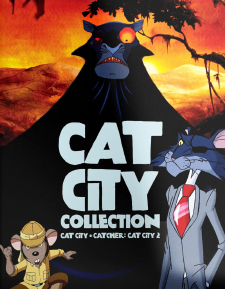
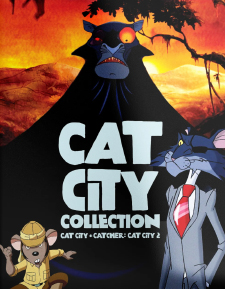
Deaf Crocodile’s Blu-ray release of the Cat City Collection is a two-disc set with each film and its extras on a separate disc. (While the extras for Cat City are identical to Deaf Crocodile’s 2023 solo release, it’s been re-authored here with new menus and slightly different audio options.) It also includes a 48-page booklet featuring essays by Walter Chaw, Dan Schindel, and Anna Ida Orosz, as well as a slipcover featuring artwork by Beth Morris. The set is limited to 1,000 units, although Deaf Crocodile is also releasing a standard version that omits the slipcover (although it does appear to retain the booklet). We’ll address each disc separately here:
DISC ONE: CAT CITY
As the Star Wars style opening title scrawl indicates, Cat City set in the year 80 A.M.M. (After Mickey Mouse) on the Planet X. The civilian mice of Planet X have been threatened with extinction by multinational criminal gangs of bloodthirsty cats, so the covert spy agency Intermouse turns to their best operative Grabovszky (László Sinkó) in order to retrieve plans for a device that can stop the threat once and for all. The Blofeld-style feline supervillain Mr. Gatto (János Körmendi) wants to keep those plans out of the hands of his archrivals, so he gives his lieutenant Mr. Teufel (Miklós Benedek) the task of stopping Grabovszky by any means necessary. That includes hiring a group of rat mercenaries called the Four Gangsters (András Kern , Gyula Szombathy, Ilona Béres, and Zsuzsa Pálos) who are constantly on Grabovszky’s heels despite the fact that he’s getting some outside assistance from the likes of the friendly vampire bat Gutsy Max (Gyula Bodrogi) and a robot dog called the Cat Catcher. Yet sometimes it takes an ordinary proletarian Joe to save the day, and where the superspy Grabovszky may fail, the schlubby police officer Lazy Dick (István Mikó) will succeed. True revolutionary success doesn’t necessarily come from the elites.
Cat City offers a fascinating mélange of ideas that don’t fit neatly into any simple boxes. That’s partly due to the unique nature of animation in both Eastern Europe and Asia. In the West, animation is frequently organized into the broad categories of family entertainment and adult animation, while the lines between the two are far more blurred in the East. Still, the reality of Western animation has never been quite as simple as that. When legendary animators like Tex Avery, Chuck Jones, and Bob Clampett were making their classic Merrie Melodies and Looney Tunes shorts, they weren’t really aiming them at children, but they weren’t necessarily targeting adult audiences, either. Instead, they made their cartoons just to amuse themselves—and generations of audiences were happy to come along for the ride. In that sense, Cat City really is a spiritual heir to classic Warner Bros. animation. Ternovszky, Nepp, and their team of animators were having fun with the limitless possibilities of the medium, doing whatever happened to tickle their own fancies, and they achieved a similar kind of universal appeal for Hungarian audiences.
Cat City is replete with sight gags, in-jokes, puns, and other references (not all of which translate well into English). It includes some surrealistic touches right out of the Zucker-Abrams-Zucker school of comedy, like when Grabovszky is talking into a police radio and then suddenly starts using it as an electric razor instead. (In fact, ZAZ had already used a variation of that exact same joke in Kentucky Fried Movie.) There are also a few Tex Avery style gags such as when the exhaust trails from a group of rockets ties themselves into knots. There’s even a handful of Ralph Bakshi style postmodern flourishes, especially during the musical numbers like the Four Gangsters advertisement that convinces Mr. Teufel to hire the mercenaries. (In that case, it’s also a blatant lift of the music from the 1947 Woody Herman instrumental Four Brothers, with vocals added in a similar fashion to what The Manhattan Transfer did on their 1978 album Pastiche.)
All that, and it’s not even beginning to scratch the surface of the ways in which Cat City critiques both Soviet oppression and the feckless nature of the Hungarian bureaucracy. There’s a lot to digest in Cat City, which is one reason why it has remained such a perennial favorite in Hungary. It’s a bit violent by the standards of Western animation, although most of that violence is completely bloodless. Still, there’s a hefty body count by the end. That’s something that has never bothered Hungarian audiences, and it shouldn’t serve as a barrier for Western ones either. Animation is far too multifaceted an art form to dismiss as being simple “kid’s stuff.” There’s nothing even remotely simple about Cat City, so hopefully Western animation fans can learn to love it the same way that Hungarian audiences already have.
Cat City was created via traditional cel animation and photographed on 35 mm film by cinematographers Csaba Nagy, Mária Neményi, and György Varga, framed at the full Academy aperture of 1.37:1. This version utilizes a 4K restoration that was performed at the Hungarian Film Lab in 2018 under the aegis of the National Film Institute-Film Archive of Hungary. The negative was actually scanned at full 6K resolution, with the rest of the restoration work being finished in 4K. The resulting image is clean and free of damage, but with all of the fine detail and grain intact. While the animation itself is relatively simple, there’s plenty of detail in the watercolor background paintings—they have some real texture to them. The overall color design of the film is relatively muted, favoring browns, tans, and blues, but it does get a bit brighter during sequences like the Four Gangsters musical number. Everything runs at a consistently high bitrate, and there are no encoding artifacts of note. This is another winner from Deaf Crocodile that perfectly shows off the wonderful world of classic Eastern Bloc animation.
Audio is offered in Hungarian 2.0 stereo DTS-HD Master Audio, with removable English subtitles. Cat City was originally recorded and released in mono, so this remastered stereo track just applies a bit of processing in order to provide a pseudo-stereo presence. There’s a bit of support feeding into the main left and right channels, but the reality is that everything still remains firmly anchored to the center channel. Regardless, it’s a clean mix with little in the way of distortion, noise, or other issues. The Hungarian dialogue is always clear, and the music by Tamás Deák and Jimmy Giuffre sounds fairly robust. There was an English-language dub for the film, but it hasn’t been included here, and note that the 5.1 track from Deaf Crocodile’s 2023 release also hasn’t been included (but there was little practical difference between it and this 2.0 version anyway).
The following archival extras are included, all of them in HD:
- Commentary with Samm Deighan
- Modern Training Methods (6:24)
- Let Us Keep a Dog (6:00)
- Where Is the Limit (7:03)
- Interview with György Ráduly (45:02)
- The Director Answers: Béla Ternovszky (23:14)
- Ahead of Its Time (26:53)
- We Just Made It for the Fun of It (30:39)
The commentary is by author and film historian Samm Deighan, and she gives a broad history of Hungarian animation in general as well as an overview of Cat City in particular. She explains the ways in which Hungarian animation pulled from different artistic backgrounds, including references to American and European cinema at large. She talks about how the popularity of animation in Hungary meant that audiences were up for anything, adults and children alike. She also does her best to try and decipher some of the puns and other references that don’t translate well into English. In the end, she sees Cat City as a left-wing critique of Soviet-style communism, in contrast with the anti-communist propaganda of the west.
Modern Training Methods (aka Modern edzésmódszerek), Let Us Keep a Dog (aka Tartsunk kutyát!), and Where is the Limit (aka Mindennek van határa) are all short subjects written by Nepp and directed by Ternovszky. Modern Training Methods (1970) is a ruthless satire of the athletic world, with its protagonist suffering the tortures of the damned while undergoing a rigorous athletic training program across a variety of disciplines. (Success always comes at a cost.) Let Us Keep a Dog (1974) turns to the world of pet ownership instead, offering a catalogue of various arguments in favor of owning a dog—needless to say, the canines frequently manage to turn the tables on their masters. Where Is the Limit (1975) provides a commentary on the world of animation itself, with its cheerfully irrepressible orange-skinned protagonist never letting the travails of being an animated character get him down—that is, until he finally figures out a way to escape into the real world, where the law of unintended consequences always applies. There’s no information available regarding the mastering work done on these three shorts, but they do appear to have benefited from the same kind of restoration efforts as Cat City—they’re in terrific shape.
Ahead of Its Time is a 2020 video essay produced by the National Film Institute of Hungary, hosted by film historian Zoltán Varga. Varga examines the circumstances behind the creation of Cat City and explains its significance to Hungarian animation in general. He also provides a brief look at the career of Béla Ternovszky. We Just Made It for the Fun of It is a 2020 interview with Ternovszky, who also talks about his own career while covering the making of Cat City. It’s not just a static interview, though, because it’s filled with film clips, behind-the-scenes footage, and samples of the original artwork.
The Director Answers: Béla Ternovszky is a new 2023 interview with Ternovszky that covers some similar ground, but it’s focused more broadly on his career as a whole. It also includes some different clips and artwork than what’s seen in We Just Made It for the Fun of It. Finally, the Interview with György Ráduly is an extended zoom chat between Ráduly and Deaf Crocodile’s Dennis Bartok. They discuss the restoration process as well as a variety of other topics related to the film. (Ráduly says that the original audio stems were no longer available, so that explains why remixes are just processed mono.)
CAT CITY (FILM/VIDEO/AUDIO/EXTRAS): B/A/B+/A-
DISC TWO: CATCHER: CAT CITY 2
Catcher: Cat City 2 (aka Macskafogó 2 – A sátán macskája, more accurately translated as Cat Catcher 2: Satan’s Cat) was produced two decades after Cat City, so appropriately enough, it’s set two decades later as well (the opening titles don’t give the year this time, but presumably it’s 100 A.M.M.) Since Grabovszky’s efforts with the Cat Catcher have led to the complete defeat of the cats, they’re now thoroughly domesticated and serve the mice doing menial tasks (including, amusingly enough, pushing the title scrawl up the screen). And with the cats no longer being a threat, the Cat Catcher has fallen into disuse.
The journalist Henry Moron Stanley (Péter Rudolf) is deep in the heart of Pafrica searching for Sir David Livingstone (Sándor Makay), where he ends up encountering a primitive tribe of cats who have retained the old world order with mice as their prey. They’re dismayed to discover that the roles have been reversed everywhere else, so they do a bit of that old black magic and summon the evil cat spirit Moloch (Gábor Reviczky) to turn the tides and free their brothers and sisters from the control of the mice. That means reviving the influence of cat gangs led by Mr. Gatto (voiced by Péter Balázs this time) and Mr. Teufel (Miklós Benedek), which also puts everyone on a collision course with the likes of Grabovszky (László Sinkó), Gutsy Max (Gyula Bodrogi), the Four Gangsters (András Kern, Gyula Szombathy, Ilona Béres, and Zsuzsa Pálos), and even Lazy Dick (István Mikó). Oh, and needless to say, it also means taking the Cat Catcher out of mothballs.
Cat City 2 takes its time establishing the new characters and the new conflict, which also means that it has plenty of time to play with some rather dicey racial stereotypes with the native cats and mice. Gutsy Max was already a little borderline, but he was such a cheerfully brash character that it still felt fairly innocuous. But Ternovszky pushes his luck here with some of the native characterizations. Fortunately, Moloch takes over once he enters the story and completely overshadows everything else, at least until he reaches the outside world and the returning characters from Cat City come into play. The years haven’t been kind to all of them, with the Four Gangsters in particular looking the worse for wear after the passage of time (although at least they’re no longer working for the cats). Most of the rest of the original characters appear as well, and not just the likes of Grabovszky and Mr. Gatto, but even the elderly couple who had their television stolen but not their TV Guide (and yes, history does repeat itself).
What hasn’t changed over the last two decades is all of the pop culture and musical references, which come just as fast and furious here as they did in the original Cat City. When the native cats discuss summoning help from the underworld, their leader misremembers Moloch’s name: "Mick? A great musician with a sympathy for the devil." During the militaristic conflict toward the end of the film, one of the officers wonders where the stormtrooper are, and his lieutenant responds, “With all due respects, sir, they’re in another film.” (Cat City 2 also openly refers to that final battle as being just like Godzilla vs. Mechagodzilla). There’s even a stray Snagglepuss reference with an “Exit, stage left.” Needless to say, the puns still come fast and furious as well, from Moloch’s boss being named Purr-cifer to his return to the underworld with an acquiescent “To hell with me.” The world may have changed since the original Cat City was released in 1986, but Cat City 2 proves that if there’s one constant in the universe, it’s that talented animators like Ternovszky will always take full advantage of the limitless possibilities of the medium in any and all of its forms.
Ternovszky certainly took advantage of the move from traditional hand-drawn animation to the digital realm, incorporating fluid camerawork in 3D space that wouldn’t have been practical with the cel animation in Cat City. (He even uses the new digital trickery to throw in a reference to The Matrix with a “bullet time” shot.) Yet if there’s one thing that’s lost in Cat City 2, it’s the savage sociopolitical critique of the original film, which is the inevitable result of the fact that there was less to push back against in 2007. That means Cat City 2 doesn’t hit as hard as its predecessor did, and any remaining cultural critique is oblique enough that it will be lost on Western audiences. Yet Ternovszky’s animation remains as universal as ever, and the direct line from Tom & Jerry to Danger Mouse and the worlds of the Cat City franchise means that it’s still accessible to anyone with a lifelong love of the medium, regardless of age or national boundaries. Animation is the one truly global language, and when Ternovszky speaks it, he’s talking to all of us.
Catcher: Cat City 2 was animated digitally using a combination of 2D and 3D elements, with the digital files scanned out to film for theatrical release, framed at 1.85:1 for theatrical release (it’s been opened up to full frame 1.78:1 here in this native digital version). While that does mean that some of the handcrafted textures of Cat City have been lost, the animation is as stylish as ever. Those textures aren’t completely missing, however, since many of the backgrounds were still hand-painted and then scanned into the computer, so they do retain some that tactile quality from the original film. The move to digital animation does mean that everything is immaculate, with no traces of any of the imperfections of traditional cel animation, but that also means everything is bigger, bolder, and more colorful—the muted colors scheme of the original film has been replaced by a riotous shades of color, especially in Pafrica. While there are some jaggies visible along diagonal lines in the digitally rendered artwork, that’s just part of the original production and not a defect in this rendition of it. As a representation of the digital animation that was done for Cat City 2, this is essentially perfect.
Audio is offered in Hungarian 5.1 DTS-HD Master Audio, with removable English subtitles. Catcher: Cat City 2 was produced in 5.1, and this is a wildly active surround mix with plenty of surround activity, especially in Pafrica with the sounds of the jungle making the environments feel more immersive. The bass doesn’t dig the deepest, but there’s plenty of support in the low end when Moloch and the Cat Catcher face off in their epic kaiju confrontation. The lively score was composed by Miklos Malek this time around, and while none of the songs are as catchy as the Four Gangsters number in the first film (hey, Woody Herman is a tough act to follow), it’s still an energetic musical accompaniment to Ternovszky’s inventive visuals.
The following new extras are included, all of them in HD:
- Commentary by Dorian Saisse
- The Satirical, Postmodern World of Cat City (15:49)
- Interview with Béla Ternovszky (45:42)
The commentary features animator Dorain Saisse, who says that he’s the father of two cats, so he has more experiences to bring to bear than just technical ones. But he does recommend listening to Samm Deighan’s commentary for Cat Catcher first to supply some background about the franchise, since he doesn’t want to repeat what she had to say and would rather strike his own path. So instead, he dives deeply into the differences in animation styles and the advantages that digital animation can offer. He explores the differences in the stories and the new characters, including some of the punny names that don’t translate well into English, and how the “Satan’s Cat” subtitle is actually a reference to the Hungarian translation of The Hound of the Baskervilles. Saisse also traces the complicated nature of the coproduction between the remnants of Pannónia Filmstúdió, Saint Audio Studio, and Szerep Produkciós Iroda, and addresses thornier subject matter like the problematic racial representations. Overall, his commentary does have less of a historical focus than Deighan’s did, but he still has much to say that illuminates the world of Catcher: Cat City 2.
The Satirical, Postmodern World of Cat City is a visual essay by YouTuber Evan Chester that offers an overview of Béla Ternovszky’s career and the Cat City series. For the first film, he breaks down a few of the characters and their referents (yes, some of them were indeed based on Bond villains) and some of the other allusions at play. He also comments on the Cold War setting. For the second film, he notes the differences in animation styles and the way that the old characters are gradually integrated with the new ones. Since the new villain is named Moloch, Chester examines some of the connotations involved with that name, and notes the other references involved in the film (a few of which are easy to miss).
The interview with Ternovszky was conducted online by Deaf Crocodile’s Dennis Bartok, with Anna Klaniczay serving as translator. (They had an acoustic feedback or latency problem that causes some echoing, but everything is still comprehensible.) Bartok goes all the way back to ground zero by asking Ternovszky about his childhood, how he got into filmmaking, and his influences. From there, they work through the Cat City franchise, starting with the first film and its inspirations. Ternovszky confirms that the Manhattan Transfer’s version of Woody Herman’s Four Brothers was indeed the inspiration for Four Gangsters, and he also discusses where they had to rein in their imaginations, like when they eliminated a shot of blood appearing under a door that sounds like a reference to the opening scene in The Leopard Man. They didn’t want to tarnish the success of the first film with a sequel, which is one reason why it took so long for Catcher: Cat City 2 to see the light of day. Yet once the financing finally came together, they were actually fascinated with trying to figure out where to take the story after the otherwise conclusive ending of Cat City. But it was a great experience working once again with some of his old collaborators like the original voice cast. Ternovszky also discusses the different working methodology with digital animation.
CATCHER: CAT CITY 2 (FILM/VIDEO/AUDIO/EXTRAS): B-/A/A-/B
It’s a great slate of extras to accompany beautiful presentations of Cat City and Catcher: Cat City 2. Deaf Crocodile has been performing an invaluable service by making Eastern Bloc fantasy and animation available to Western audiences. From Alexandr Ptushko classics like Ilya Muromets to unforgettable Czech stop-motion films like The Pied Piper to Romanian animation like The Son of the Stars, they’ve been consistently knocking it out of the park with these kinds of releases. The Cat City Collection is no exception, and it’s a must purchase for fans of animation in all of its stripes and colors. If you’re not already familiar with Hungarian animation in general and Béla Ternovszky in particular, this is an excellent place to start. Highly recommended.
- Stephen Bjork
(You can follow Stephen on social media at these links: Twitter, Facebook, BlueSky, and Letterboxd).