
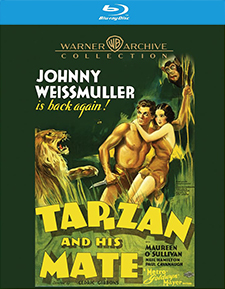
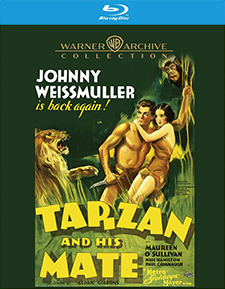
Tarzan and His Mate (Blu-ray Review)
Director
Cedric GibbonsRelease Date(s)
1934 (February 24, 2026)Studio(s)
Metro-Goldwyn-Mayer (Warner Archive Collection)- Film/Program Grade: A
- Video Grade: A-
- Audio Grade: A-
- Extras Grade: B-

Review
There were more than 30 Tarzan movies made between 1932-1970, but the best by far is Tarzan and His Mate (1934). One of the emblematic pre-Code films, famous for its nudity, less so for its still-harrowing violence, this and its predecessor, Tarzan the Ape Man (1932), the first films of the “official” Tarzan movies, were far grittier than MGM’s later, homogenized and even dopey entries before they turned the property over to RKO. That studio’s 1940s entries were generally far superior to later MGM films like Tarzan’s New York Adventure (1941). The series went downhill during the mid- to late-1950s, then revitalized by producer Sy Weintraub with Tarzan’s Greatest Adventure (1959), one of the best of the series, though for my money the later Tarzans peaked with two epic entries starring lithe Jock Mahoney: Tarzan Goes to India (1962) and Tarzan’s Three Challenges (1963).
But I get ahead of myself. In Tarzan the Ape Man, the first of the Johnny Weissmuller Tarzans, was inspired in large measure by success of Trader Horn, the Harry Carey African adventure made the previous year. This first Tarzan’s main shortcoming is the heavily reliance on stock footage from that earlier hit, seen in endless rear-screen and other primitive process shots. The movie itself, however, still holds up remarkably well, with Harry Holt (Neil Hamilton, later famous as Commissioner Gordon on TV’s Batman) leading crusty James Parker (C. Aubrey Smith) and Parker’s daughter Jane (Maureen O’Sullivan) deep into uncharted Africa, in search of the mythical “Elephant’s Graveyard.” The band eventually ascends the perilous Mutia Escarpment, where a curious Tarzan (Weissmuller) whisks Jane away to his treetop lair. There’s no "Me Tarzan. You Jane" in any of the Weissmuller pictures. Instead, their first meeting begins thusly:
Tarzan: “Tarzan. Jane. Tarzan. Jane. Tarzan. Jane. Tarzan. Jane. Tarzan. Jane. Tarzan. Jane.”
Jane: “Oh please, stop!”
The film is mostly an exciting, genuinely tense adventure, highlighted by a scary attack by a tribe of bloodthirsty dwarves who lower their prisoners into a pit holding a monster gorilla. As one might expect, the film is almost hilariously politically incorrect. Climbing the Mutia Escarpment, one of the pack-bearers loses his footing and falls thousands of feet to his death. Before he even hits bottom, Holt crassly asks, “What was in that pack?” When the natives begin getting restless, Holt instructs their black foreman, “Well, you’ve got your whip. Give them something else to think of.”
If it weren’t for all the routine and occasionally lousy Tarzan movies that followed, Tarzan and His Mate would be regarded as one of the all-time classics, a picture nearly as thrilling and imaginative as King Kong (1933). Warner Archive’s Blu-ray release features the complete, 105-minute pre-release version, which was shorn of about 23 minutes during its theatrical run and subsequent reissues and television airings. If you’ve never seen this incredible film, and assume all classic Hollywood films are puritanical and tame, you’re in for a shock.
A direct sequel set “nearly a year” after the events in Tarzan the Ape Man, the film has Harry Holt (Neil Hamilton again) joining ne’er-do-well Martin Arlington (Paul Cavanaugh) for a second expedition: to retrieve the valuable ivory found at the Elephant’s Graveyard, and try to win Jane back from Tarzan and return her to civilization. Things go wrong almost immediately, as two scoundrels steal Holt’s map and are (very) gruesomely murdered and their bodies mutilated by hostile natives.
After the success of the previous Tarzan and the colossal returns on RKO’s King Kong, MGM accorded Tarzan and His Mate a lavishness unequaled in a Tarzan picture until Hugh Hudson’s 1984 Greystoke. The exterior sets are extremely elaborate, and the number of extras and animals used in this film is genuinely staggering. The care paid off: the film is far more atmospheric and more believably (if mythically) African than any other film in the MGM series.
Better still, it’s a perfect blend of tense action and racy, romantic sexuality. Jane’s one-shot costume (she was far demurer in subsequent films) is very revealing, and her balletic nude swim with Tarzan borders on poetry. Part of the appeal of all the Weissmuller/O’Sullivan movies is that Tarzan and Jane clearly adore one another and have an obviously active and healthy sex life quite unusual for movies of the 1930s. The climax, in which bloodthirsty natives and man-eating lions surround the cast, cornering them against a mountainside, is a remarkable achievement; it’s incredibly suspenseful and exciting, even more than 90 years after it was made.
Though the film relies heavily on the then-relatively new rear-projection process, even in high-definition the myriad trick shots almost always impress when they’re perceptible at all. Many are simple but flawlessly executed stationary mattes, but there are also numerous more complex traveling matte shots, barely noticeable as special effects. One scene has Cheetah running from a big cat done in this manner, and later there’s an epic battle between African elephants (played by Indian ones wearing ear pieces) and lions, also mostly achieved using traveling mattes.
Once it gets past its first 15 or so minutes of expository material, setting up the narrative, Tarzan and His Mate is virtually non-stop action interspersed with Tarzan-Jane lovemaking. Tarzan grapples to the death with one animal, emerges victorious, only to be immediately attacked by another. The clever cutting of real animals, mechanical props, actors and their stunt doubles keeps it believable and exciting, and in some scenes it’s obvious the stuntmen (and women) were really risking their necks and, unfortunately, some of the animals undoubtedly suffered injury or were killed in the process. The varied nature of the material—this one has Tarzan and/or Jane battling a huge pride of lions, charging rhinos, a monster crocodile at least 25 feet long—is imaginative if occasionally preposterous: in one scene Tarzan is rescued by a passing hippopotamus, statistically one of the deadliest of mammals.
The film also touts the largest army of “gorilla men,” human actors in impressively realistic ape skins until Kubrick’s 2001: A Space Odyssey. The IMDb and other sources credit only gorilla suit veterans George Barrows and Ray Corrigan, neither wearing their personalized, identifiable ape suits, and the design of the costumes here—of which there seem to be at least 10—look more like the work of Charles Gemora.
These MGM Tarzan movies established the trope of an inarticulate Tarzan, quite the opposite of the literary character, that continued until regal-looking Lex Barker took over the part in the late-1940s. But Johnny Weissmuller more than compensates with his impressive physicality—the Gold medal Olympic swimmer is almost impossibly handsome, like a Greek God, and so utterly devoted to Jane, herself a liberated woman unimaginable in 1934, one expects the film appealing to 1930s women as much as men.
Though like Tarzan the Ape Man the film is profoundly politically incorrect at times, in its depiction of black Africans—though one could argue that the world of Tarzan is one of pure fantasy, visualizing an Africa that never existed anyway—it’s also accidentally proto-environmentalist in other respects. Raised in the jungle, Tarzan has no concept of money or capitalism, and opposes the removal of ivory from the Elephant’s Graveyard because that’s where their souls “sleep.” In other words, he regards animals no different from human beings, and removing the ivory no different from graverobbing. Likewise, when a beloved animal friend is killed saving Jane’s life, Tarzan builds its final resting place in the trees, in the manner of some Native American tribes.
Warner Archive’s new Blu-ray of Tarzan and His Mate, in 1.37:1 standard and black-and-white, looks significantly improved from the earlier DVD version though one shouldn’t expect pristine video throughout, given the jumble of stock footage, process shots, etc. The DTS-HD Master Audio (2.0 mono) is also noticeably improved, though you still might want to click on the optional English subtitles here and there to catch all the dialogue. The disc itself is Region-Free.
Included is a fascinating original trailer in remarkably good condition, but overall the extra features are disappointing. The only other supplements are two short subjects also from 1934, up-rezzed from standard definition: The Spectacle Maker, a two-reel fantasy in early Technicolor directed by Maureen O’Sullivan’s husband, John Farrow; and What Price Jazz, a musical short featuring the Ted Fio Rito Orchestra.
If you’ve never experienced a classic Tarzan movie before, this is the one to watch. Expect to be repeatedly startled. Highly Recommended.
- Stuart Galbraith IV