
State of Grace (4K UHD Review)
Director
Phil JoanouRelease Date(s)
1990 (May 13, 2026)Studio(s)
Cinehaus/Orion Pictures (Imprint Films/Via Vision Entertainment)- Film/Program Grade: A-
- Video Grade: B-
- Audio Grade: B+
- Extras Grade: B

Review
[Editor’s Note: This is a Region-Free Australian 4K Ultra HD import.]
Thanks in no small part to Martin Scorsese, the cinematic mean streets of New York are often associated with the darker side of the Italian-American community. But organized crime in the city wasn’t limited to the Italian mafia, with Irish gangsters maintaining their own presence going all the way back to the 19th century—a fact that Scorsese eventually addressed in his 2002 historical epic Gangs of New York. But a young Steven Spielberg protégé named Phil Joanou beat Scorsese to the Irish punch twelve years earlier with State of Grace, although Scorsese still ended up having the last laugh in 1990 (more on that later). Of course, State of Grace was hardly the first film to address Irish gangsters in New York, or even in Hell’s Kitchen for that matter; Angels with Dirty Faces had already done so back in 1938. But most other Irish gangster films moved the action elsewhere, like to Chicago in Public Enemy or the Boston area in The Friends of Eddie Coyle. The Coen brothers even dispensed with geography entirely by creating their own stylized, borderline mythical environs for Miller’s Crossing.
While State of Grace is set in and around the very real Hell’s Kitchen, Joanou offered his own stylized take on the genre by eschewing any kind of specific period details to give his film an intentionally timeless quality. Yet the story was inspired by an equally real group of Irish gangsters who had risen to prominence in Hell’s Kitchen during the Seventies (although they were already in decline by 1990): the Westies. Playwright Dennis McIntyre had written his fictionalized take on the Westies before Joanou came on board the project, but the director wanted to reshape the story to his own tastes, with less of an emphasis on action (although he retained the shootout for the finale). McIntyre began the process of rewriting the script, but he was growing weaker and weaker due to stomach cancer and wasn’t able to see it through to the end. Fellow dramatist David Rabe took over for him, and it’s his final draft that went before the cameras late in 1989. Sadly, McIntyre passed away before the film was released the following year, but according to Joanou, he was at least able to see the rough cut first (State of Grace would end up being his one and only screenplay credit).
Ironically enough for an Irish gangster film set in New York City, the story for State of Grace ended up foreshadowing Scorsese’s later Boston-area Irish gangland film The Departed. Terry Noonan (Sean Penn) is a Hell’s Kitchen native who returns to the neighborhood after a lengthy absence. He renews his friendship with his childhood friend Jackie Flannery (Gary Oldman) and also tries to rekindle his relationship with Jackie’s sister Kathleen (Robin Wright). He’s looking to join the gang led by their older brother Frankie (Ed Harris), although he has his own reason for doing so, a secret that will eventually put him into conflict with the aspiring mob boss. Frankie has ambitions to grow his influence beyond the borders of Hell’s Kitchen, and to make that happen, he’s willing to get in bed with the local Italian mafia led by Joe Borelli (Joe Viterelli). But when Jackie defends their friend Stevie (John C. Reilly) against some of the Italians, Frankie has to make a hard choice, and that ends up putting him even further into Terry’s crosshairs. State of Grace also stars John Turturro, Burgess Meredith, and R.D. Call.
With a cast like that, there’s no need for action scenes since the actors were able to generate plenty of fireworks of their own. When Scorsese made Mean Streets back in 1973, Robert De Niro and Harvey Keitel were still relative unknowns, and the film provided breakthrough roles for them. In comparison, Penn, Oldman, and Harris were all established stars by 1990, but that fact ended up working in Joanou’s favor. They were maverick actors with their own ideas, and they threw themselves into their roles with such intensity that their conflicts were sometimes quite authentic (an unintentional but fortuitous level of interpersonal energy that Joanou was able to capture on film). And while State of Grace does conclude with the inevitable shootout, for once it’s a gunfight that’s clearly motivated by the story and the characters—although Joanou did make the dubious decision to shoot the entire scene in slow motion, which robs it of some of the intensity that the actors had established during their earlier dramatic scenes. Still, that’s a minor misstep in a film that’s otherwise stylistically and dramatically assured.
Phil Joanou was a 28-year-old director making just his third feature film with State of Grace, which adds another interesting parallel when you consider that Martin Scorsese was 31 when he made his own third feature Mean Streets. Yet while Mean Streets ended up being as much of a breakthrough for its director as it was for the cast, Joanou had no such luck with State of Grace. Distributor Orion Pictures opted for a tiered release, hoping to build momentum as they expanded into more theatres, but fate can be a cruel mistress sometimes. The week after State of Grace opened on a handful of screens, Scorsese’s Italian-American gangster film Goodfellas opened wide, landing #1 at the box office, and Joanou’s Irish gangsters never stood a chance. Worse, while box office failure doesn’t always condemn a film to obscurity, Goodfellas dominated the critical and popular consciousness to such an overwhelming degree that State of Grace never had a fair chance to build up a proper following.
That’s a shame, because Joanou has always deserved better, and neither his critical nor commercial reputations have ever matched the quality of his work. Final Analysis was a flawed but interesting Hitchcock pastiche, and his stellar James Lee Burke adaptation Heaven’s Prisoners is almost criminally underrated and underappreciated. State of Grace may have received more critical appreciation than either of those two follow-ups, but it’s still a cult movie in search of a cult. Whatever ambitions that Phil Joanou had for State of Grace, he ended up discovering that harsh reality has no time for ideals, just like Terry Noonan realizes in the film:
“You believe in the angels or the saints or there’s such a thing as a state of grace. And you believe it. But it’s got nothing to do with reality. It just an idea. I mean, you got your ideas and you got reality.”
Cinematographer Jordan Cronenweth shot State of Grace on 35mm film using Panavision cameras with spherical lenses, framed at 1.85:1 for its theatrical release. This version is based on a 4K scan of the original camera negative, digitally remastered and graded for High Dynamic Range in Dolby Vision and HDR10. The operative word there is “based,” too, because the results of all that work have gone far astray from what Cronenweth committed to celluloid. The opening title sequence does feature a zoomed-in optical shot in the background with super chunky grain, but it’s always looked that way, even in the theatres. Unfortunately, much of the rest of the film is the now the direct opposite of that. The normal film grain has been overly managed to the point where it’s barely present for much of the film, and given the fact that speckling and other small blemishes are still visible, it wasn’t a side effect of dealing with damage to the elements. No, it was a deliberate attempt to minimize and/or eliminate grain, with varying degrees of impact to the underlying image.
Frustratingly, despite the minimized grain, many shots look quite good. But then you have shots like the closeup at 30:21 when Sean Penn and Robin Wright are dancing to the late Sinéad O’Connor’s Drink Before the War, with Penn’s forehead and nose looking smooth and waxy, while Wright’s hair looks oddly plasticized. The dolly shot of Penn and Gary Oldman at 47:38 is missing all of the textures on their faces, looking almost like upscaled DVD, and the effect gets even worse when it cuts to the closeup of Penn at 48:10. The encoding on the UHD is variable (this is one instance where Via Vision should have used Fidelity in Motion), but the same effect is still visible on the accompanying Blu-ray, so the smoothening is baked into the master and not just a compression issue. All of which is a shame, because in all other respects—contrast, color balance, etc.—this is a clear upgrade from the previous Blu-ray editions of State of Grace. But the ham-handed grain management here may be a deal breaker for some, so caveat emptor.
Audio is offered in English 5.1 DTS-HD Master Audio and 2.0 LPCM, with optional English SDH subtitles. State of Grace was released theatrically in Dolby SR, and the 2.0 track sounds like the original matrix-encoded mix, while the 5.1 track is a straightforward discrete encoding of those same four channels. Either way, it’s a subtly immersive mix that springs to life during the shootout at the end. It’s still dialogue-focused mix in general, but Ennio Morricone’s astonishingly powerful score is arguably as critical as anything else in the success of the film as a whole. That was still the height of what I like to call the composer’s “subtle dissonance” period, when he crafted scores that put viewers quietly ill-at-ease without them necessarily realizing why (Frantic would be another great example from that period).
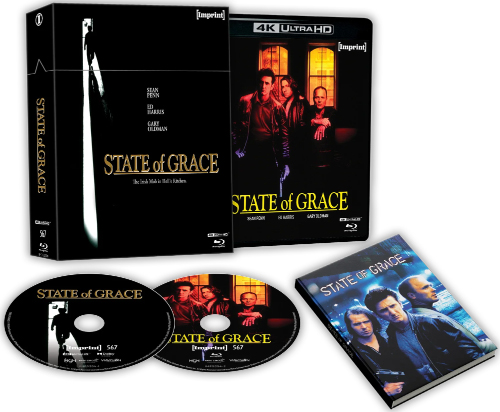
Via Vision’s Region-Free Limited Edition 4K Ultra HD release of State of Grace is #567 in their Imprint Films line. It’s a two-disc set that includes one Blu-ray with a 1080p copy of the film. There’s also a 60-page hardbound booklet featuring an essay by Rachel Walther and a reproduction of the original pressbook, including a full cast & crew listing plus production notes and cast bios. Everything comes housed in one of Imprint’s rigid Hardboxes that opens up at the top. The following extras are included:
DISC ONE: UHD
- Commentary by Phil Joanou and Nick Redman
- Isolated Score
- Trailer (Upscaled SD – 1:33)
DISC TWO: BD
- Commentary by Phil Joanou and Nick Redman
- Isolated Score
- Deleted Sequence (HD – 8:38)
- A Matter of Timing (HD – 19:21)
- Family and Blood (HD – 17:33)
- Mob Mortality in the Music of Ennio Morricone (HD – 15:06)
- The Irish Gang (HD – 10:58)
- Behind the Scenes Photo Gallery (HD – 4:11, 50 in all)
- Trailer (Upscaled SD – 1:33)
- Home Video Trailer (Upscaled SD – 2:43)
Via Vision has added several new extras for this release, starting with a Deleted Sequence with an introduction by Phil Joanou. It’s the original opening scene from the film, before the Terry Noonan character is introduced. It was meant to show the transition from the old guard in Hell’s Kitchen to the new order led by Frankie. Due to the extremely graphic way that Frankie’s gang made the transition, preview audiences walked out of the theatre, and the MPAA threatened an X rating. As a result, Joanou kept whittling it down, but ultimately decided that the whole sequence was unnecessary—although unfortunately that also meant losing a performance from the great Michael Gambon. (The footage from the completely uncut version is lost, so this is the final trimmed-down version before he dropped the entire scene.)
The rest of the new extras consist of a Photo Gallery and four interviews. A Matter of Timing is with Joanou, who breaks down the deliberately non-specific period details in the film, which were intended to avoid tying the story to any specific era. He also breaks down some of the differences between the original Dennis McIntyre draft and the final shooting script. Joanou worked with McIntrye on the rewrite process until the author’s health declined too far, and then David Rabe was brought in thanks to his relationship with Sean Penn. Joanou says that he was stuck in the middle during shooting since the actors were so intent on topping each other that the fights that broke out between their characters ended up being quite real. He also offers some interesting thoughts about working with Jordan Cronenweth and Ennio Morricone.
Family and Blood is with Jeff Cronenweth, who served as a camera assistant for his father on State of Grace. He describes his background and why he ended up in the camera department before breaking down working with Joanou on U2: Rattle and Hum and State of Grace. Cronenweth feels that you have to hold back from making things too pretty, and anything that doesn’t push the story forward in a visual way is distracting for the audience.
Mob Morality in the Music of Ennio Morricone is with film music historian Daniel Schweiger, who says that Morricone is always at his best when working with directors who have a strong vision, like Sergio Leone and Phil Joanou. Schweiger traces Morricone’s career leading up to State of Grace, including his move into the crime genre during the Eighties. He also examines the themes and instrumentation that Morricone employed in the film, noting the dissonance, and empathically states that it’s one of the composer’s best scores.
Finally, The Irish Gang is with producer Ned Dowd, who says that State of Grace was one of the first films that he produced, and then he explains how the project came together, including the cast and crew that were hired for it. Note that Via Vision’s website still lists a Hell’s Kitchen location featurette as one of the extras in the set, but not this interview, so it seems to have evolved since they made their original announcement. But Dowd does also talk about a few of the locations used in the film.
Via Vision has also ported over the Isolated Score track from Twilight Time’s 2016 Blu-ray, still in lossy 2.0 Dolby Digital, as well as their commentary track featuring Joanou and the late great Nick Redman. They open by addressing the original unused prologue and how Joanou ended up creating the zoomed-in credit sequence, including the reshoots that were done to make Terry Noonan the focus of the story after the prologue was dropped. From there, they move on to more details about the conception and production of State of Grace, from the locations to the influence of The Wild Bunch on the final shootout. Joanou also explains how (and why) he omitted the “happy” ending from the script.
There are still a few bits and bobs not included here, most notably the Directing a Bunch of Gangsters featurette and brief Ed Harris interview from Second Sight’s 2015 Region B Blu-ray in the U.K. (There was also a German-language commentary by Marco Erdmann on the 2016 Region B Blu-ray from NSM Records in Germany.) But this is unquestionably the best extras package that State of Grace has ever received. It’s just a shame that the decision was made to apply such heavy-handed grain management to the film itself—and given that Joanou approved the new 4K master, he may be the culprit. So, for good or for ill, this is the version of the film that he wants you to see. You’ll have to judge for yourself whether that’s acceptable or not.
-Stephen Bjork
(You can follow Stephen on social media at these links: Twitter, Facebook, BlueSky, and Letterboxd).