
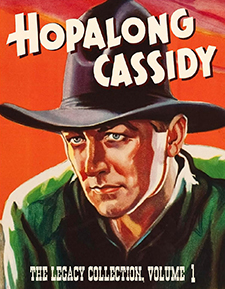
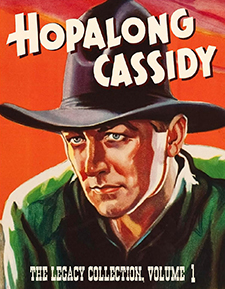
Hopalong Cassidy: The Legacy Collection Volume 1 (Blu-ray Review)
Director
Howard BrethertonRelease Date(s)
1935 (July 29, 2025)Studio(s)
Harry Sherman Production/Paramount Pictures (ClassicFlix)- Film/Program Grade: A-
- Video Grade: A-
- Audio Grade: A
- Extras Grade: A-

Review
For my money, the B-Western movie genre reached its apex with producer Harry Sherman’s Hopalong Cassidy series. Although a whopping 66 feature films were produced between 1935 and 1948, the movies peaked from roughly from 1936-39; these several dozen are more adult and less predictable than most B-Westerns, including the later Hoppy fetures, and had by far the best triumvirate of leads: William Boyd as Hopalong Cassidy, James Ellison as Johnny Nelson, later replaced by the even better Russell Hayden as “Lucky” Jenkins, and the greatest of all Western sidekicks, George “Gabby” Hayes as Windy Halliday.
The movies, and the 1949-52 television series that followed, also starring Boyd, became positively beloved by several generations of fans. It would not be an exaggeration to state that, in the early 1950s, William Boyd/Hopalong Cassidy—by then the two were interchangeable—was the most famous man in America, more instantly recognizable even than Walt Disney, Clark Gable or, for that matter, the President of the United States.
The best Hoppy films have a beguiling charm almost entirely absent from, say, the ordinary B-Westerns of Whip Wilson, Johnny Mack Brown, or even Gene Autry, whose 1930s musical B-Westerns sold tickets like A-movies at the box office. Other than the equally beloved Roy Rogers, whom kids looked up to like a big brother, Hoppy, more of a father figure, was one of a kind, a paragon of virtue and decency so sorely lacking in much of the American landscape today. Long before the Kirk-Spock-McCoy or Luke-Leia-Han, the Hoppy films all but established the contrasting buddy trio.
In the movies, Hoppy was a pillar of common-sense wisdom, absurdly clean-cut (“Hey bartender, give me a sarsaparilla!”) with an infectious, nasally laugh, a cautious man of action, strategically waiting for the right moment to take down rustlers and corrupt businessmen. Twenty-somethings Johnny Nelson and later Lucky Jenkins, by contrast, were impetuous, always throwing caution to the wind and getting into trouble when not falling in love with some ranch owner’s daughter. Johnny was more the hothead than Lucky would be; Johnny also tended to suspect the worst in people, even doubting Hoppy’s motives more than once. Lucky was more the unformed, wide-eyed innocent epitome of callow youth, though each would mercilessly tease toothless old coot Windy Halliday, who had no use for women but like Johnny and Lucky unabashedly idolized Hoppy.
I first encountered the series via Image Entertainment’s DVD releases in the early 2000s, which consisted of most of the films through the early 1940s and packaged as double-feature discs. These were good video transfers for that time and I quickly became a die-hard Hoppy fan. When those releases dried up, I turned to far less satisfying releases from bottom-feeder DVD labels, that released the later, more juvenile movies (and the TV series). These releases also used good masters, but presented them at such extraordinarily low bit-rates they were almost unwatchable.
ClassicFlix’s Hopalong Cassidy: The Legacy Collection Volume 1 is a most welcome release of the first three Hoppy films, all from 1935: Hop-Along Cassidy, The Eagle’s Brood, and Bar 20 Rides Again. In releasing them chronologically, one can trace the gradual establishment of the sure-fire Hoppy formula. They’re more primitive than later Hoppy films—there’s too little underscoring, for instance—and the classical triumvirate hasn’t yet formed: George Hayes appears in all three pictures, but in disconnected supporting roles, and the lovable old man is even murdered in the first two. Other characters clearly intended as regulars, such as likable Frank McGlynn, Jr. as “Red” Connors (later the name of Edgar Buchanan’s sidekick on the TV series) would soon disappear altogether. But the strong casts and especially the series’ excellent use of less-overworked locations, particularly Lone Pine, California, are already in place. While by no means expensive, the early Hoppy films were lavish, polished productions compared to most B-Westerns.
A major star of the silent era, William Boyd’s career in talkies derailed when in 1931 another actor also named William Boyd was arrested on gambling and liquor charges and the public confused the two. The future Hopalong realized the series was his best last chance to revive his career, and over the next 20 years, like Roy Rogers and Clayton Moore (the Lone Ranger), the character personally transformed the man into a reflection of his screen image.
And yet Boyd was an improbable Western hero. Only a fair horseback rider, Boyd was 40 years old when the series began and his wispy, slicked-back hair had already gone white. He had a strange, nasally Oklahoman accent that made his line deliveries a little peculiar at times; he’s like an adult version of Donnie Dunagan, the child actor whose thick southern accent was so wildly out of place in Son of Frankenstein. Conversely, Boyd’s performance is impressively committed; Hoppy is genial but quietly determined to root out rustlers and the like, and the early films allow him to express his anger, if understatedly so. Most importantly he’s an ideal role model for Johnny Nelson and, later Lucky Jenkins, Hoppy clearly the intelligent, unassuming leader.
The later Hoppy films and especially the television series were clearly geared for children, but the early Hoppys could be surprisingly adult and occasionally unexpectedly violent—these pictures were so unimportant, the Production Code probably barely paid any attention to them. Yet in one 1930s Hoppy a helpless old man in a wheelchair is lassoed and dragged by one of the villains, until man and chair crash spectacularly against a buckboard.
Though formulaic, the early Hopalong films, including The Eagle’s Brood here, experimented with the tried-and-true B-Western formula. That film revolves more around Hoppy’s relationship with Mexican outlaw El Toro (William Farnum) than Johnny or George Hayes’s character, and even puts Hoppy in a perilous near-death encounter with quicksand, generating unusual suspense. In the later Outlaws of the Desert, Hoppy & Co. even traveled to the Middle East to buy horses, prompting critic Leonard Maltin to note Hoppy’s “heretofore unknown fluency in Arabic.”
ClassicFlix’s Hopalong Cassidy: The Legacy Collection Volume 1 makes a bit of a gamble going the chronological route. For one thing, the three pictures don’t really represent the best Hoppy entries, though Bar 20 Rides Again comes close; the best Hoppy films would soon follow. For another, while Hop-Along Cassidy and Bar 20 Rides Again look stupendous, 1.37:1 standard, black-and-white transfers from original 35mm elements, The Eagle’s Brood, by far the most problematic of the 66 Hoppy features in terms of existing film elements, had no choice but to resort to 16mm as the 35mm pre-print elements are lost. Except, that is, for a single reel, about 10 minutes, in the middle of the film when the picture suddenly bursts into extreme, fleeting clarity. Still, overall The Eagle’s Brood is a big improvement over Image’s earlier DVD. The mono audio on all three pictures is also vastly improved, and optional English subtitles are provided on this Region “A” encoded disc. (And it is one disc; the combined running time is 183 minutes, each film running about an hour.)
The extra features are a delight. They include audio commentaries by Ed Hulse on Hop-Along Cassidy and Toby Roan on Bar 20 Rides Again, but the real treats here are the documentary William Boyd: Becoming Hopalong Cassidy, which is loaded with great stills and film clips; Hopalong in Hoppyland, a star-studded news film of the opening of the 1951-54 amusement part in Venice, California; bonus reels of silent outtakes from the 1930s era, a fascinating and extremely rare look behind-the-scenes; an original trailer for The Eagle’s Brood, and an image gallery.
Those who’ve never experienced the best B-Westerns, particularly fans of A-Westerns like Shane, The Searchers, and Rio Bravo, don’t know what they’re missing. While this Legacy Collection doesn’t exactly open with the best or most representative Hopalong Cassidy films, it does ease its audience in quite nicely. Highly Recommended!
- Stuart Galbraith IV