
Harry and the Hendersons (4K UHD Review)
Director
William DearRelease Date(s)
1987 (May 25, 2026)Studio(s)
Amblin Entertainment/Universal Pictures (Kino Lorber Studio Classsics)- Film/Program Grade: C+
- Video Grade: A-
- Audio Grade: B+
- Extras Grade: B

Review
As any true fan of cryptid cinema can attest, it’s a surprisingly versatile genre, capable of telling any kind of story in nearly any context. So, it’s not too surprising that someone eventually got around to making what was essentially an urban sitcom featuring Bigfoot, and that’s exactly what writer/director William Dear did in 1987 with Harry and the Hendersons. Yet the journey to reach that point wasn’t exactly a straightforward one, and appropriately enough, the concept started out as a pitch for an actual sitcom by William E. Martin and Ezra D. Rappaport. That series never got off the ground, but Dear saw the potential and rewrote their treatment as a full script for a potential feature film. He had already worked on Steven Spielberg’s Amazing Stories television series, so he brought the project to Amblin Entertainment, and the rest became history—or not quite history, that is, because you may be able to take the Bigfoot out of the sitcom, but you can’t take the sitcom out of the Bigfoot. But more on that in a moment.
Dear’s script may have been written as a big screen Bigfoot, but the story never strays too far from its sitcom roots. The film opens with the Henderson family on a camping trip in the woods. George (John Lithgow) is the son (and employee) of a sporting goods store owner George Sr. (M. Emmet Walsh), and he fancies himself something of a big game hunter. He’s teaching his own son Ernie (Joshua Rudoy) how to hunt rabbit, over the objections of his longsuffering wife Nancy (Melinda Dillon). Meanwhile their daughter Sarah (Margaret Langrick) wants nothing to do with any of it. So far, so standard sitcom family dynamics.
On the drive home, George accidentally hits some wildlife, and it turns out to be Bigfoot himself (Kevin Peter Hall). Thinking the shaggy beast is dead, they take the body home, only for it to come to life unexpectedly, and sitcom shenanigans ensue. Bigfoot turns out to be a gentle giant who isn’t particularly impressed by George’s taxidermy collection (although he seems to be more pescatarian than vegetarian, since he’s only too happy to eat the family’s pet goldfish). While George initially dreams of making big money with Bigfoot, once he recognizes the intrinsically sweet nature of Harry, he decides to protect the beast instead. That puts the whole family (Harry included) in the crossfire between their nosy neighbor Irene (Lainie Kazan, playing the Lainie Kazan role), a hunter who wants to bag a Bigfoot (David Suchet), a roadside Bigfoot museum owner (Don Ameche), the police, the media, and more. Will they find a way to keep Harry safe? It’s a glorified sitcom, so what do you think?
As Bilbo Baggins might say, Dear’s rather simple story is stretched out awfully thin at 110 minutes, like butter scraped over too much bread. Of course, this was the Eighties, so he tried to juice up the drama by adding a character who is trying to kill or dissect the creature a la Iceman, Splash, and Starman, although at least this time it’s not the government. (Oh, and as an Eighties family comedy, a male character also takes the inevitable shot to the groin.) Yet tonally, that dramatic element never quite squares with the rest of the film. Sure, even Alf had his own nemesis in the form of the Alien Task Force, but for what’s essentially a feature-length sitcom, LaFluer just feels too incongruously “evil” for most of the film. (And yes, that whole story angle is in service of the somewhat muddled anti-animal cruelty theme in Harry and the Hendersons, but Suchet sells the mendaciousness of LaFleur a bit too well.)
Yet despite the thin story, unnecessary elements, and muddled messaging, Harry and the Hendersons still works thanks to one simple factor: Harry. The 7’2” Kevin Peter Hall was something of a gentle giant of his own, and while he still remains the best performer ever to don a Predator suit, he was never comfortable with the violence and cruelty in that series. Harry was a character after his own heart, and makeup artist Rick Baker took full advantage of that fact by ensuring that it was Hall’s own expressive eyes that were visible behind all of the animatronics. Baker ended up taking home an Oscar for his work, but that honor belonged as much to Hall as it did to the artist who designed the makeup.
Dear clearly recognized that he had something good on his hands with Harry, and as a result, Harry and the Hendersons tugs at the heartstrings with all the subtlety of a salt bath for a burn victim. But let’s face it: Steven Spielberg’s own films aren’t exactly subtle when it comes to selling the emotional effects, and he’s as shamelessly manipulative as any director who has ever stepped behind the camera. It’s just that Spielberg is one of the best in the business when it comes to audience manipulation, and William Dear is no Steven Spielberg. On the other hand, Harry and the Hendersons is still just a big sitcom at heart, and as anyone who has ever watched a Very Special Episode can attest, sitcoms are hardly a model of subtlety anyway.
And that, finally, brings us full circle. Harry and the Hendersons was modestly successful in 1987, perhaps not enough so to warrant a full sequel, but it did spawn (you guessed it): a syndicated family sitcom that ran for three seasons. While none of the human cast returned, Kevin Peter Hall did don the suit once more, at least for the first season. Tragically, he contracted HIV from a blood transfusion that he received after a car accident in 1990, and barely a year later, he passed away from AIDS-related pneumonia. Yet while Predator, Predator 2, and Harry and the Hendersons all stand as a tribute to his talents as a suit performer, only Harry and the Hendersons serves as a reminder of the nature of the gentle giant who brought all of those characters to life. The film may have its deficiencies, but it’s still a worthy part of Hall’s legacy, and a testament to the fact that the best makeup in the world is nothing without someone inside it in order to help bring it to life.
(One unrelated side note: the opening of Harry and the Hendersons, including the Universal logo, the first titles, Bruce Broughton’s score, the sound effects, and the fade into the film itself, looks and sounds uncannily like the opening from Spielberg’s Jurassic Park, made just four years later. Spielberg may be a shameless manipulator, but he’s not above being a shameless borrower as well. He may have only been an uncredited executive producer on Harry and the Hendersons, but clearly, he was paying attention.)
Cinematographer Allen Daviau shot Harry and the Hendersons on 35mm film using Panavision Panaflex cameras with spherical lenses, framed at 1.85:1 for theatrical release. This new Universal Pictures-supplied master is based on a 4K scan of the original camera negative, digitally remastered and graded for High Dynamic Range in Dolby Vision and HDR10. While the opening titles and the handful of opticals throughout the rest of the film are a bit soft, the rest of the image is generally sharp and well-resolved, with only a few single-frame blemishes visible (and if you’re not looking at the exact part of the frame where they occur, you’ll never even notice them). The contrast range is excellent, with the highlights standing out more than they do on standard Blu-ray but without ever overcooking things. If there’s one flaw here, it’s Kino Lorber’s encoding, which doesn’t always handle the grain particularly well. It’s most noticeable with swirling patterns in the sky, but there are also unnatural-looking patterns on some of those highlights. As usual, it’s the kind of thing that’s far more visible in screenshots than it is in motion, but it’s definitely noticeable if you go looking for it.
Audio is offered in English 5.1 and 2.0 DTS-HD Master Audio, with optional English subtitles. Harry and the Hendersons was released theatrically in Dolby Stereo, and the 2.0 track here does sound like the original mix with encoded surrounds, while the 5.1 track is a fairly basic discrete encoding of the same mix—there’s no real LFE engagement or split surround activity. Either way, the surrounds provide ambient effects throughout the film like wildlife sounds in the forest and urban noises in the city. But there’s not much in the way of directionalized effects, just general ambience. There’s not much depth to the bass, either, with Harry’s footsteps lacking any real low-end punch. But the dialogue is clear, and Bruce Broughton’s occasionally saccharine score is reproduced well (although the less said about his Joe Cocker song Love Lives On, the better). Comparing the two tracks, the 5.1 version offers more precise steering while the 2.0 sounds a bit more expansive, so I preferred the 2.0, but your own mileage may vary.
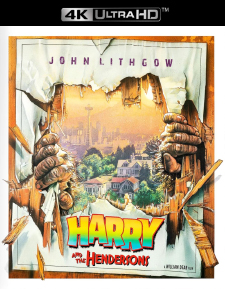
The Kino Lorber 4K Ultra HD release of Harry and the Hendersons is a two-disc set that includes a Blu-ray with a 1080p copy of the film, as well as a slipcover that duplicates the theatrical poster artwork on the insert. The following extras are included:
DISC ONE: UHD
- Commentary by William Dear
- Commentary by Joe Ramoni
- Archival Commentary by William Dear
DISC TWO: BD
- Commentary by William Dear
- Commentary by Joe Ramoni
- Archival Commentary by William Dear
- Harry... Finding the Missing Link (SD – 17:20)
- Making of Harry and the Hendersons (SD – 5:39)
- Newswrap (SD – 2:35)
- Deleted Scenes (SD – 2:26 + 3:33, 4 in all)
- Harry and the Hendersons Trailer (HD – 1:58)
- Uforia Trailer (HD – :57)
- Continental Divide Trailer (SD – 2:52)
- Hot Pursuit Trailer (Upscaled – SD 1:54)
- Honky Tonk Freeway Trailer (SD – 2:40)
Kino Lorber has added two new extras for this release, both of them commentary tracks. The first is with William Dear, moderated by Kino’s Douglas Hosdale. They step through the basics of how the project came together, followed by practical details about the production itself like the design of Harry, the makeup, the casting, the cinematography, the locations, and working with Steven Spielberg. Dear also discusses the challenges in getting the Academy to recognize the work of Rick Baker.
The second new commentary features Joe Ramoni from Hats Off Entertainment. Ramoni offers more of an appreciation of Harry and the Hendersons¸ which he calls one of his favorite Eighties family comedies because he actually appreciates the simplistic, sitcom nature of the premise. But he also provides some third-person perspectives on the production and release of the Harry and the Hendersons, from the stellar work by Rick Baker and Kevin Peter Hall to the problematic way that Universal marketed the film. He also discusses the television spinoff.
The archival extras include the original William Dear commentary from Universal’s 2007 Special Edition DVD. Sans moderator, he’s a bit more prone to lapsing to silence, but he still has some interesting things to say. While he admits in the new commentary that he’s never really done one looking back at one of his films with that much distance (nearly four decades!), this DVD commentary was “only” twenty years down the road, so his perspective is slightly different. He still covers similar material to what he does in the new track, but from a different (and fresher) angle.
Harry... Finding the Missing Link, Making of Harry and the Hendersons, and Newswrap also came from the 2007 DVD. Finding the Missing Link focuses on the design of Harry, Rick Baker’s makeup, and Kevin Peter Hall’s performance. While it uses a rather silly (and pointless) framing device, once it gets to the goods, they’re quite good indeed since there’s plenty of behind-the-scenes footage from Baker’s workshop and glimpses of Hall at work. Making of Harry and the Hendersons is a pretty basic EPK reel, narrated by John Lithgow, that includes brief interviews with Lithgow, Joshua Rudoy, David Suchet, Lainie Kazan, Melinda Dillon, Margaret Langrick, and William Dear. The Newswrap is an even briefer promotional featurette, using much of the same interview footage.
Finally, there’s a set of Deleted Scenes that were added for the 2014 Universal Blu-ray, although they appear to have been supplemented for this release. While there’s only a single menu selection, it starts with a new deleted scene running 2:26, and then jumps to the original collection of three different scenes running 3:33 total. The “new” scene is set between Harry watching the man use a pooper scooper with his dog, and his eventual discovery by some the suburban homeowners. In this case, there’s an extended moment while he watches a birthday party through a window (the whole scene seems to serve as a setup for why Harry is holding a dollar bill after he corrals LaFleur at the end of the film).
It’s a great new 4K master (although a less than perfect encode), all of the previously available extras, and a couple of new ones as the icing on the cake. If you’re a fan of cryptid cinema in general and/or Harry and the Hendersons in particular, Kino’s 4K version is a no-brainer.
-Stephen Bjork
(You can follow Stephen on social media at these links: Twitter, Facebook, BlueSky, and Letterboxd).