
Directed By... David Lean – Volume One (1942 – 1948) (Blu-ray Review)
- Review Date: Aug 19, 2025
- Format: Blu-ray Disc
-


Director
David Lean, Noël CowardRelease Date(s)
1942-1948 (June 18, 2025)Studio(s)
British Lion/Eagle-Lion/General Film Distributors (Imprint Films/Via Vision Entertainment)- Film/Program Grade: See Below
- Video Grade: See Below
- Audio Grade: See Below
- Extras Grade: A-
- Overall Grade: A


Review
[Editor's Note: This is a Region-Free Australian Blu-ray import.]
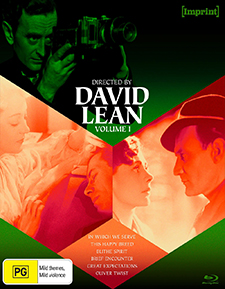
Imprint’s hefty Directed By... David Lean – Volume One (1942 – 1948) is an impressive boxed set chronologically tracing the first part of Lean’s directorial career. Beginning in the late silent era, Lean (1908-1991) worked his way up through the Gainsborough ranks, first as a teaboy, then a clapper boy and third assistant director, before landing in the editing department, where he quickly gained a reputation as one of Britain’s finest cutters.
For In Which We Serve (1942), writer-director-star-music composer Noël Coward engaged Lean to cut the film and direct its action scenes, as Coward’s directorial experience had been limited to the theater. Coward quickly realized Lean knew the mechanics of filmmaking far better than he, and with Coward also appearing in front of the camera for significant stretches, promoted Lean to co-director. (However, in the opening credits, Coward managed to have his name appear something like seven times. Subsequent collaborations were billed as “Noël Coward’s This Happy Breed” and so forth, his producer credit appearing last in the opening titles, after Lean’s directing credit.)
It also appears Coward worked closely with Lean and cinematographer (soon to become a producer and later director) Ronald Neame to whittle Coward’s 8-9-hour screenplay to a manageable length. As it is, the non-linear story is mostly a series of character and action-scene vignettes.
The destroyer HMS Torrin is attacked by German bombers during the Battle of Crete and is sunk. As survivors—including Capt. E.V. Kinross (Coward), CPO Walter Hardy (Bernard Miles), Ordinary Seaman Shorty Blake (John Mills) and others—cling to a life raft and repeatedly strafed by German fighters, the story of these men and especially their ship is told in fragmentary flashbacks.
In these flashbacks we meet Kinross’s wife, Alix (Celia Johnson) and their two children, Bobby (Daniel Massey) and Lavinia (Ann Stephens), with Alix resigned to a life shared with the Torrin competing for her husband’s affections. CPO Hardy has a warm relationship with his wife, Kath (Joyce Carey), and later when Shorty marries Freda Lewis (Kay Walsh) and she becomes pregnant, she moves in with Kath and her elderly mother.
At sea the crew of the Torrin help rescue soldiers from Dunkirk, while during the Battle of Narvik the ship is damaged by a torpedo strike, and struggles to return to England for repairs. Kinross, insisting on a “happy and efficient” ship, earns his crew’s loyalty, even taking responsibility for a young stoker (Richard Attenborough, in his film debut) who loses his nerve in the heat of battle.
In Which We Serve is remarkably similar to the later The Cruel Sea (1953); the latter film never comes close to plagiarizing Coward’s film, yet the story is uncannily similar in many respects, with the same character types and situations both in battle and on the home front. Probably because Coward’s screenplay had to be distilled into a manageable length, dramatically The Cruel Sea is far sturdier and ultimately superior, while In Which We Serve has an immediacy the other film lacks—when it was made the outcome of the war was anything but certain—and it necessarily is more the patriotic flag-waver, though not to the extreme of Hollywood wartime movies.
Both films are impressively realistic, though The Cruel Sea, with its benefit of hindsight, is darker, grimmer in some ways. Both show the complicated system operating a fighting ship, from the pecking order of men and their specialized duties to the mechanics involved. In Which We Serve is especially good demonstrating the complex task of moving shells from the lower decks into the big guns. Both pictures have excellent special effects. They’re so good at times it’s hard to tell real footage from the miniatures and matte paintings.
Each film in the set is a joint restoration of the David Lean Foundation, the BFI, and ITV, in this case the 1080p 1.37:1 standard frame black-and-white appearing crisp with excellent blacks and contrast throughout, which is also true of the monochrome titles here. The LPCM 2.0 mono, again all six discs, is likewise strong, and supported by excellent optional English subtitles. All six films are Region-Free.
Supplements-wise, each film has “An Appreciation” video segment with professor Melanie Williams, author of David Lean (2025). Additional extras here include a 1969 audio recording of Coward and Attenborough at London’s National Film Theatre, and an older featurette, A Profile of In Which We Serve.
IN WHICH WE SERVE (FILM/VIDEO/AUDIO): A-/A/A
I had not seen This Happy Breed (1944) and Blithe Spirit (1945) since the VHS era, when I thought both were just okay—these gorgeous HD restorations went a long way to change my mind regarding the former. Watching This Happy Breed again was something of a revelation; not only does the image sparkle throughout, the production is most impressive, even though most of it takes place inside a typically cramped English rowhouse, while the acting and screenplay are uniformly excellent. I first saw the film as a young adult; now, nearly 60, I’m much more receptive to its warm, bittersweet depiction of the passing of time within several generations of Brits between two World Wars.
The picture, narrated by Laurence Olivier, covers the everyday lives of Gibbons family—patriarch Frank (Robert Newton), his wife Ethel (Celia Johnson), their three children Reg (John Blythe), Vi (Eileen Erskine), and Queenie (Kay Walsh, particularly luminous), along with Frank’s widowed sister Sylvia (Alison Leggatt) and Ethel’s elderly mother (Amy Veness)—in a rented house in South London. Moving into the home in 1919, Frank is delighted to discover that his next-door neighbor is Bob Mitchell (Stanley Holloway), a friend from the Great War. Bob’s son Billy (John Mills) immediately falls for Queenie, but she has other plans.
Based on Noël Coward’s 1939 play, the film integrates the family’s growth and changes with contemporary references: the British Empire Exhibition, the General Strike of 1926, the pre-war rise of the British Union of Fascists, the death of King George V and so on, while the adult children gradually marry and have children of their own.
The picture methodically, almost imperceptivity draws in its audience, so that by the last half-hour, when tragedy strikes and rifts within the family seem irreparable, it elicits unanticipated emotion from its viewers. On one hand, it’s very Anglo-centric in many of its details, yet has an Ozu-like universality as Frank and Ethel accept the inevitable changes that come with the passage of time, as they age and their children leave home.
From that long-ago VHS viewing, I had remembered This Happy Breed as being very stagy, claustrophobic, and play-like, but it was not a cheap production, costing $900,000. That’s due, no doubt, to the brief but lavish crowd scenes on London streets, of the amazing recreation of the British Empire Exhibition to the British Union of Fascists rally, and so forth. There’s even a big short scene with an actor playing Neville Chamberlain at 10 Downing Street celebrating “peace in our time” in 1938.
Coward had played Frank on the stage, but Lean and his team, including again Ronald Neame, who photographed and co-wrote and co-produced, wisely rejected him in favor of Robert Newton, excellent among the peerless cast. Johnson, Walsh, Holloway all are superb.
The restoration of this three-strip Technicolor production is as good as the best work of the Warner Archive, though there is a slight glitch in the presentation. A vertical line appears on the far-right side of the 16:9 frame throughout the film. It’s nowhere near the 1.37:1 frame, thankfully, and may not be visible on all monitors but it was present on my projector system.
Besides Williams’s appreciation, this title includes a restoration demonstration, an original and re-release trailer, and still gallery.
THIS HAPPY BREED (FILM/VIDEO/AUDIO): A/A/A
Alas, the fine restoration of the three-strip Technicolor Blithe Spirit (1945) did little to dissuade this reviewer’s mostly negative opinion of the film, a mostly unfunny, too-straightforward adaptation of Noël Coward’s hit play. It’s not as if David Lean had no sense of humor—his later Hobson’s Choice (1954) is hilarious, and dry, sardonic humor permeates his filmography—but frothy drawing room comedy was not his cup of tea, and it shows. As one-quarter of the Cineguild team that included Coward, Lean, and Ronald Neame, Anthony Havelock-Allan nailed the unhappy film’s faults, which he argued had as much to do with the casting of the three leads as anything else.
Middle-aged novelist Charles Condomine (Rex Harrison), researching an occult novel he’s writing, invites medium Madame Arcati (Margaret Rutherford) to perform a séance following a dinner party hosted by Charles and his wife, Ruth (Constance Cummings), and including Dr. George Bradman (Hugh Wakefield) and his wife, Violet (Joyce Carey).
Though the others can barely contain their laughter at Madame Arcati’s eccentrici behavior, she performs her task only too well—later that evening the ghost of Elvira (Kay Hammond), Charles’s dead first wife, appears, visible to Charles but not Ruth nor anyone else. Though initially Elvira is delighted to see her husband again and delights in teasing the unbelieving Ruth, Charles clearly has one wife too many, and seeks Madame Arcati’s help to send Elvira back to the Other World.
As Havelock pointed out in interviews, the biggest problems with Blithe Spirit are that, per the original play, Charles should be middle-aged and set in his ways (Cecil Parker played him on the stage), married to a rather plain, equally middle-aged Ruth. Elvira should be young, sexy, and vivacious, stirring memories of youth within Charles. In Lean’s film, however, Rex Harrison and Constance Cummings are too young-looking and energetic, with Ruth appearing both younger and more attractive than Elvira. Further, Kay Hammond, who played Elvira on stage, has a slow, rather garbled delivery at odds with Harrison’s clipped one. Indeed, Hammond at times speaks as if her mouth was stuffed with bonbons.
Lean and Neame felt the usual double-exposure methods of cinematic ghosts old-fashioned, while Coward wanted to retain the “green ghost” look of the stage version. To accomplish this, Hammond was fitted with a green wig and liquid green makeup, while Neame was tasked with spotlighting her and only her with green-filtered lighting effects. My recollection of earlier home video versions was of a kind of ethereal green glow around Elvira much of the time, but in the new restoration Neame’s special lighting effects are barely noticeable, adding to the staginess of the film. Incredibly, Blithe Spirit won an Academy Award for its Special Visual Effects, even though it has but a handful of opticals, far fewer in number and much less complicated than anything in, say, The Invisible Man’s Revenge (1944).
What’s left is a movie not particularly better than Hal Roach’s funnier “Topper” films beyond Coward’s witty dialogue and the delightful Margaret Rutherford, who almost single-handedly salvages the enterprise as the unpredictable, dotty medium.
The main extra here is an hour-long, 1992 episode of The South Bank Show offering a retrospective of Noël Coward, hosted by Melvyn Bragg. A theatrical trailer is also included.
BLITHE SPIRIT (FILM/VIDEO/AUDIO): B-/A/A
Everything that seemed to go wrong with Blithe Spirit went in the opposite direction and then some for Lean & Co. on Brief Encounter (1945), one of his best. Everyone, even Celia Johnson, famous for her dislike of film work, had a grand time making it, and while based on yet another Coward stage piece, it feels much more Lean’s film than Coward’s.
Set just before the war, the story opens in a railway station refreshment room (a kind of station platform pub), where garrulous Dolly Messiter (Everley Gregg), a middle-aged housewife, imposes herself on acquaintance Laura Jesson (Celia Johnson), seated at a table with Dr. Alec Harvey (Trevor Howard). As she dominates the conversation with her nosy questions, Alec rushes to catch his train, and after a few moments Laura disappears but soon returns, feeling faint.
Arriving home to her waiting husband, Fred (Cyril Ramond), and their children, she silently reflects on the past weeks, her narration heard by the movie audience but not her husband. Every Thursday she takes the train to Milford, in Surrey, to shop and catch a matinee at one of the movie theaters there. One evening at the refreshment room, waiting for her train home, soot gets in one of her eyes and passerby Alec gently removes it, and that, so it would seem, is that.
But the following Thursday she runs to Alec at the chemist and, the week after that, they eat lunch and catch a movie together. Against all logic, they’ve fallen in love, which they guiltily confess to one another. They continue spending time together in secret, and consider consummating their romance at the flat of Alec’s friend, but her guilt seems an uncrossable barrier.
Brief Encounter is one of the great romantic films because Lean and his collaborators firmly stick to the appeal of its simplicity and ordinariness. Ruddy, pock-faced Howard was virtually an unknown, having only film to his credit, a supporting role. Celia Johnson, only in her mid-thirties, looked ten years older than she was, her deeply-etched face offset by those enormously expressive, saucer-like eyes. As stiff and uncertain as Rex Harrison is in Blithe Spirit, Howard is entirely naturalistic and believable, and Johnson is the English Everywoman personified.
Middle-class English audiences found them highly relatable, particularly in their angst over falling so deeply, so passionately in love on one hand, but duty-bound to their respective spouses and children who, after all, also love them, even though Celia’s Fred is hardly demonstrative. Their furtive feelings toward one another blossoms realistically, neither anxious to declare their feelings while struggling to contain the longings welling up inside them.
They do the things all burgeoning lovers do: eat together, laugh at absurdities like the all-woman classical trio hired to entertain restaurant goers; they shop together, go to the picture show, where they laugh at Donald Duck and Lean shows us and them a trailer for a hilariously dreadful-looking jungle adventure, “Flames of Passion.”
Offering relief to all the inevitable heartbreak is the flirtatious banter between ticket inspector Godby (Stanley Holloway) and Myrtle (Joyce Carey again), owner of the refreshment counter. As others have pointed out, beyond offering little breaks between all the romantic drama, they serve an ironic counterpoint: Laura and Alec can only express their feelings in private, while Godby and Myrtle can only express theirs in public.
Extras here include the documentary Before the Epic: David Lean’s Little Gems – Part One, by writer Simon Lewis; new interviews with actress Margaret Barton, actor Richard Thomas, and production secretary Renée Glynne; A Profile of Brief Encounterfeaturette, and a theatrical trailer.
BRIEF ENCOUNTER (FILM/VIDEO/AUDIO): A/A/A
Free of Coward, Lean’s directorial rise reached full flower with Great Expectations (1946), one of the greatest films ever made. From Charles Dickens’s 1861 novel, it follows the life of the orphan Pip (Anthony Wager), who lives with his shrewish older sister (Freda Jackson) and her gentle blacksmith husband, Joe Gargery (Bernard Miles). Visiting his parents’ grave, he runs, literally, into the clutches of an escaped convict, Magwitch (Finlay Currie), who demands food and blacksmith’s tools to remove his chains, threatening Pip if he does not comply. Pip returns the next morning, his empathy and kindness impressing the hardened criminal who is later recaptured.
Later, eccentric spinster Miss Havisham (Martita Hunt), who hasn’t set foot beyond in her stately but rotting, cobweb-filled home since she was jilted on her wedding day decades earlier, the petrified cake untouched in the dining hall, sends for Pip to provide company for her adopted daughter, Estella (Jean Simmons). Pip immediately falls in love with her, but Miss Havisham is grooming Estella for a life of cruelty toward all men, revenge by proxy.
When he’s 20 years old (and now played by John Mills), Pip is visited by Miss Havisham’s lawyer, Mr. Jaggers (Francis L. Sullivan), who informs Pip that a mysterious benefactor has offered to finance Pip’s transformation into a gentleman, a man of “great expectations,” and which includes a generous allowance. Rooming with the more experienced Herbert Pocket (Alec Guinness, in his credited film debut), Pip hopes this transformation will allow him to reunite with Estella (now played by Valerie Hobson), whom he still loves, despite her cold-heartedness.
From its unforgettable opening scenes of young Pip visiting the eerie cemetery and shock encounter with Magwitch (Finlay Currie, an unusual casting choice, is superb) to the Gothic stuck-in-time virtual haunted house of Miss Havisham, with Martita Hunt unforgettable in that role, Lean’s film has a moody, narrative sweep that carries its story along—with its several big surprises—in a manner that’s irresistibly compelling. It has a very authentic early/mid-19th century feel, yet Lean doesn’t shy away from Dickens’s colorful, extravagantly conceived characters.
The performers enacting them are almost uniformly superb, particularly Miles, Currie, Sullivan, Hunt, Jackson, and Ivor Bernard as Mr. Wemmick, Jaggers’s sympathetic clerk. It took some chutzpah casting 38-year-old John Mills as 20-year-old Pip, but Mills so go good in the part the fact that he’s way too old for it is easily dismissed.
The romance between Pip and Estella plays reasonably well, but it’s the scenes between Pip and Joe and Pip and Magwitch that are the heart of the film. The versatile Bernard Miles plays Joe Gargery with a wide-eyed methodical innocence, uneducated but with an innate kindness of spirit. The scenes where Pip, now a man of means, is embarrassed by Joe’s unexpected, clumsy visit to his flat, Pip trying to contain his snobbish contempt for a lowbrow man he loved, is painful to watch, no matter how many times one sees the film. Likewise, a major revelation involving Magwitch is beautifully realized, Pip initially horrified by the sudden plot twist, yet he gradually becomes completely devoted to this improbable father figure.
The cinematography by Guy Green and Robert Krasker is peerless; it’s among the most striking black-and-white films ever made, equaled by John Bryan and Wilfred Shingleton’s art direction.
Simply put, Great Expectations is one of the greatest films ever made.
Rather surprisingly, beyond Williams’s appreciation the only other extra is a trailer.
GREAT EXPECTATIONS (FILM/VIDEO/AUDIO): A+/A/A
Lean couldn’t resist another go at Dickens, finding the narrative and characters of Oliver Twist (1948) equally compelling, but while his film version has many of the same high achievements of Great Expectations, even surpassing it in a couple of respect, somehow overall it doesn’t play as well. Individual moments are just as compelling, such as Oliver’s mother about to give birth at the ominous gates of the workhouse, during a fierce thunderstorm, yet the movie plays like a series of grimly beautiful set pieces. One argument, borne out in the film, is that Lean just didn’t have the heart to put Oliver through the wringer the way Dickens did.
Cruelly treated in the workhouse by Mr. Bumble (Francis L. Sullivan) and matron Widow Corney (Mary Clare), and after astonishing all by daring to ask for more gruel, Oliver (John Howard Davies) is sold off as an apprentice to undertaker Mr. Sowerberry (Gibb McLaughlin) and his wife (Kathleen Harrison). But when Sowerberry’s senior apprentice insults Oliver’s mother, the young Oliver flies into a rage and runs away to London, where he falls in with young pickpocket the Artful Dodger (Anthony Newley), top dog of a band of boys overseen by mercurial thief Fagin (Alec Guinness), who fences stolen goods aided by Monks (Ralph Truman), coincidentally Oliver’s half-brother.
The sickly Oliver is arrested, falsely accused of pickpocketing when he was merely observing the Artful Dodger in action, but the intended victim, wealthy Mr. Brownlow (Henry Stephenson), takes pity on the lad and brings home the sickly boy. However, fearing Oliver will grass on Fagin, Monks, and sadistic thief Bill Sykes (top-billed Robert Newton), Bill and his abused lover, Nancy (Kay Walsh) plan to kidnap Oliver and return him to the fold.
An even more extravagant production than Great Expectations, Oliver Twist’s depiction of mid-19th century London still impresses with its beautifully realized production design (incorporating forced-perspective sets) and black-and-white cinematography. (Lavish as it is, during one chase scene one can see a supposedly solid brick wall in an alleyway wobble like a curtain as people rush past it.)
Where Great Expectations is told almost entirely through Pip’s eyes, Oliver Twist has many long stretches without the boy, character vignettes focusing on Fagin, Bill and Nancy, Mr. Bumble as so forth, and while colorful the film has less the narrative thrust of Great Expectations, and plays more like a series of exquisitely done set pieces. Lean’s direction (and direction of the cutting) is particularly impressive in the last half-hour, however, a masterclass of framing and cutting.
Particularly impressive is Sikes’s brutal murder of Nancy. Instead of graphically showing it, Lean cuts to the reactions of Sikes’s abused, vicious pitbull, trapped in the same room and so terrified during Sikes’s bludgeoning of Nancy that in its panicked state it claws at a locked door, trying to get out. The dog’s reaction makes the scene absolutely terrifying. (My pal Stephen Bowie and I once spent a delightful afternoon with producer Ronald Neame at his Beverly Hills home, where I asked him, “What did you do to that poor dog to get him to react that way?” An amused Neame explained they didn’t harm the pooch at all; they simply put its favorite toy on the other side of the door.)
Newton, despite advancing alcoholism, Walsh, and Davies are all excellent. Guinness’s Fagin is played at a different level, the actor affecting a croaky voice and hidden under wispy, matted hair and heavy makeup, including an outrageous proboscis based on Cruikshank’s original drawings. This drew the ire of anti-Semitic groups, which protested the film and delayed its U.S. release several years, shorn of much critical footage. But in Lean’s film Fagin is a thief who happens to be Jewish in the same way as Bill Sykes is a (more brutal) thief who happens to be a gentile. Israelis were generally anti-British at the time, protesting British films of all kinds, zeroing in on Lean’s film for obvious reasons. But as detailed in Kevin Brownlow’s superb biography of Lean, the director, with his Quaker upbringing, anti-Semitism was the furthest thing from his mind; the film never once refers to Fagin as being Jewish, and Guinness insisted he did not play him that way, either.
Once again, beyond Williams’s appreciation, the only extra is a trailer.
OLIVER TWIST (FILM/VIDEO/AUDIO): A-/A/A

Directed By... David Lean – Volume One (1942 – 1948) comes in an attractive, impressively sturdy box, six films on six discs, each with its own Blu-ray case with appealing artwork. This set is limited to 1,500 copies.
Even though I had several of the title on Blu-ray already, and most of the rest on DVD, and despite other labels releasing deluxe releases of these titles in various combinations, I found Directed By... David Lean – Volume One (1942 – 1948) to be exceedingly rewarding and worthwhile. Highly Recommended.
- Stuart Galbraith IV