
Bridge Too Far, A (Blu-ray Review)

Director
Richard AttenboroughRelease Date(s)
1977 (March 24, 2026)Studio(s)
Joseph E. Levine Productions/United Artists (Kino Lorber Studio Classics)- Film/Program Grade: A-
- Video Grade: B+
- Audio Grade: A-
- Extras Grade: B-

Review
“Madness!” is James Donald’s legendary final line in The Bridge on the River Kwai, a one-word summation of everything that had led up to that point in the story. Madness is also what it takes to mount epic productions on the scale that filmmakers like David Lean did. “They just don’t make ’em like that anymore” is a common enough mantra these days, but it’s a painfully accurate one now that digital effects have rendered that level of practical excess unnecessary. Yet the era of epic filmmaking actually ended long before digital magic became reality. Just twenty years after Lean’s bridge blew up in decisive fashion, Richard Attenborough stepped behind the cameras to tell the equally mad story of another series of bridges during World War II, and on a scale that was the textbook definition of madness, too. When A Bridge Too Far was released in 1977, it was already an anachronism not just because it was a WWII movie released shortly after the end of the Vietnam War, but also because it represented the kind of expensive all-star epic filmmaking that studios were growing wary of financing. And they didn’t really do that in this case, either. The only reason why A Bridge Too Far was ever greenlit in the first place was thanks to financial backing from an independent source, but we’ll come back to that later.
A Bridge Too Far is based on the book by Cornelius Ryan, documenting the numerous mistakes that were made during the planning and execution of Operation Market Garden in 1944. After the success of the Operation Overlord invasion at Normandy, Allied forces pursued the retreating German army, but supplying the troops and equipment became an increasing challenge. Market Garden was intended to be the solution to that problem. The brainchild of Field General Montgomery, it consisted of two simultaneous phases. “Market” was the aerial component, where the American 82nd and 101st Airborne Divisions, as well as the British 1st Airborne Division, would drop behind enemy lines in Holland to capture key bridges in Eindhoven, Son, Veghel, Grave, Nijmegen, Oosterbeek, and Arnhem. “Garden” was the ground component, which would consist primarily of elements of the British armored XXX Corps racing along that corridor in order to help secure each of the positions. Unfortunately, they didn’t make it all the way. Thanks to poor planning, mistaken assumptions, bad weather, logistical issues, and just plain bad luck, the 1st Airborne Division at Arnhem never received the support that they needed, and they had to abandon the position, losing three-quarters of their men in the process as either casualties or prisoners of war. And they were far from the only casualties, too.
Market Garden was a massive operation that spanned a week of time, and it also involved one of the largest airdrops in military history. Streamlining all of that for a feature film was no mean feat, but fortunately William Goldman was up to the task. His script for A Bridge Too Far condenses many of the specific details and characters, fictionalizing a few minor points along the way, but it remains largely faithful to the historical events. As an international operation involving British, American, and Polish forces, there will always be debate over who to blame for its failure, but Goldman threaded that needle as best he could. Montgomery is completely absent from the film, which may seem odd, but it’s true that he wasn’t directly involved with any of the events that it depicts. Instead, the focus is on Lieutenant-General Browning (Dirk Bogarde), who was the one responsible for executing Montgomery’s ambitious plan. Browning’s portrayal in the film has been a bit controversial, but while Goldman’s process of simplification may have put a little too much of the blame on his shoulders, that was arguably a necessary evil in order to keep the complex events of Market Garden as comprehensible as possible for viewers who may be unfamiliar with the operation.
However much that Goldman may have streamlined Ryan’s book at the scripting stage, making it work onscreen still required the right kind of casting in order to keep viewers oriented, so A Bridge Too Far opted for the all-star approach. The lead roles are played by an impressive ensemble that includes Bogarde, James Caan, Michael Caine, Sean Connery, Edward Fox, Elliott Gould, Gene Hackman, Anthony Hopkins, Hardy Krüger, Laurence Olivier, Ryan O’Neal, Robert Redford, Maximillian Schell, and Liv Ullmann. Other smaller roles are filled out by recognizable actors like Paul Maxwell, Stephen Moore, Michael Byrne, Alun Armstrong, Denholm Elliott, Arthur Hill, and John Ratzenberger. It would have been easy to get lost with a story that jumps back and forth from location to location, but it helps to have familiar faces to anchor each of them. (The all-star cast also served another important purpose before a single frame of the film was ever shot, but we’re still circling our way back to that point.)
While that kind of stunt casting can prove distracting and even ruin the immersion with some kinds of historical films, it serves an invaluable purpose in this case. That’s because it functions as a shorthand method of defining the characters without having to resort to pages of dialogue. The events of A Bridge Too Far are complicated enough without having to keep track of unfamiliar characters. Yet from the first moment that you see actors like James Caan and Elliott Gould onscreen, you already possess all the necessary information in order to understand Staff Sergeant Eddie Dohun and Colonel Robert Stout. As a result, everything that they do during the course of the film makes perfect sense. And aside from Gene Hackman’s dodgy Polish accent, all of the actors are perfectly cast for their roles. You don’t really need heavy-handed characterization when you cast the right character actors, and A Bridge Too Far is proof of the efficacy of that approach.
Still, a mess of an operation like Market Garden could have resulted in a mess of a film without the right field marshal to hold all of it together, and A Bridge Too Far found the perfect leader in the form of Richard Attenborough. Attenborough may have seemed like a counterintuitive choice of director back in 1977, but he ended up demonstrating his unparalleled gift for marshalling massive productions like this. He actually pulled off something that Montgomery couldn’t: he completed the mission successfully, on time and on budget. Attenborough filmed on the real locations as much as was possible, and he made sure that everything looked as authentic as possible, even if it wasn’t always 100% accurate (compromises inevitably do have to me made). A Bridge Too far is old-school epic filmmaking of the type that was already out of vogue in 1977, and it will never be seen again, either. That includes Attenborough’s extraordinary recreation of the air drop itself, and while there are a few optical effects sprinkled throughout the sequence, he did as much as possible for real. The production scraped up 11 vintage C-47 Dakotas and dropped hundreds of real paratroopers, with Attenborough setting up nearly 20 cameras in order to capture the event in documentary fashion. There’s never been anything else quite like it in a feature film.
Yet while A Bridge Too Far does indeed demonstrate Attenborough’s skills in handling epic productions, it’s not really a Richard Attenborough film in the same way that his passion project Gandhi would be just a few years later—in this case, he was still a director-for-hire. No, the real author of A Bridge Too Far arguably isn’t Attenborough, Goldman, or even Cornelius Ryan, but rather producer Joseph E. Levine. Levine came out of retirement in order to make A Bridge Too Far on Ryan’s behalf, and he financed the entire film out of his own pocket—and at a budget of $25 million, A Bridge Too Far was the one of most expensive films ever made up to that point in time (in terms of actual budget, not necessarily counting cost overruns like on Cleopatra). However risky that may seem, he actually managed to make a profit before the film ever reached the theatres thanks to his aggressive presales in various foreign markets (and that’s where the all-star cast proved crucial). Making A Bridge Too Far was madness in 1977, so it took a special kind of madman to bring everything to fruition. Levine fit that bill to a T. A Bridge Too Far might have been Ryan’s book, Goldman’s screenplay, and Attenborough’s film, but it was Joseph E. Levine’s baby.
Cinematographer Geoffrey Unsworth shot A Bridge Too Far on 35mm film using Panavision cameras with anamorphic Panaspeed lenses, framed at 2.35:1 for its theatrical release (with 70mm blowups cropped for full-frame 2.20:1). Unsworth told American Cinematographer that the light in Holland tended to be naturally diffuse, with desaturated colors, so he wanted to replicate that look on film. To that end, he used #2 fog filters for most of the production (with #1 filters as needed depending on the weather conditions), plus an abundance of smoke. Attenborough marveled to ASC that Unsworth was able to “shoot varying stops, in varying light, under varying cloud base, in varying degrees of visibility” and somehow manage to make all of that disparate footage match reasonably well. There are still some continuity mismatches throughout the film, but for the most part, it’s all surprisingly seamless.
This version is based on a 4K scan of the original camera negative that was performed on a Lasergraphics Director scanner in 2-flash mode. Fidelity in Motion handled the majority of the remastering, including the digital cleanup work and grading. The previous Blu-ray master was based on a 2K scan of an interpositive, and the improvements from the new scan are striking regardless of how diffuse the original cinematography may have been. Anyone familiar with Unsworth’s work from the period will know what to expect; A Bridge Too Far will never be as finely detailed as the best that the format can offer. Yet it’s arguably sharper than what theatrical prints would have looked like in 1977, even in lowly HD. There’s still some minor speckling and a few fleeting scratches (most of them of the single-frame variety). Aside from a few hairs at the bottom edge of the frame, all other remaining damage is negligible.
Unsworth used Eastman 5247 for the majority of the film, and the grain structure in this version looks fine, at least when viewed in motion from normal seating distances, but the Blu-ray encode struggles to keep up with it when examined more closely. Any shots with optical effects (like all of the identifying titles and a handful of travelling mattes) were derived from an IP instead, so they’re naturally even softer, with coarser grain. (Fortunately, the subtitles for this version are generated by the player, so the shots behind them have all the clarity that a negative scan can provide.) The colors look essentially perfect here, neither oversaturated nor as desaturated as post-Saving Private Ryan WWII films tend to be. All of the color hasn’t been drained out of the image, and yet it captures that hazy look that Unsworth wanted to replicate. The colors may not be bright, but there are a lot of subtle variations in the shadings, like with the variety of greens in the first shot of James Caan inside his tent. A Bridge Too Far will never be demo material, but this version is still a substantial improvement over the old Blu-ray versions.
Audio is offered in English 5.1 and 2.0 DTS-HD Master Audio, with optional English subtitles. A Bridge Too Far was primarily released in optical mono, but there were some 35mm prints with 4-track mag soundtracks and 70mm prints with 6-track mag soundtracks (with the latter in all likelihood utilizing the same basic four channel mix). None of them were Dolby-encoded. This 5.1 track appears to be the original four channel L/C/R/mono surround, just reconfigured for the 5.1 matrix. There are strongly directionalized sound effects across the front channels with limited ambient effects in the rear, which is pretty typical for that era. The dynamics are also limited compared to modern digital mixes, but there’s still a bit of punch to the gunfire and explosions. The best news is that John Addison’s iconic score has real depth and heft to it, with plenty of sparkle on the top end (something that’s often lacking from older films).
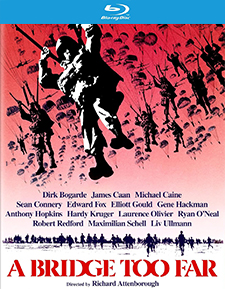
The Kino Lorber Blu-ray release of A Bridge Too Far comes with a slipcover that matches the theatrical artwork on the insert. The following extras are included:
- Commentary by Steve Mitchell and Steven Jay Rubin
- Commentary by William Goldman and the Crew
- Trailer (HD – 3:18)
- Wake Island Trailer (SD – 2:08)
- Five Graves to Cairo Trailer (SD – 2:13)
- Sands of Iwo Jima Trailer (SD – 1:53)
- The Bridges at Toko-Ri Trailer (SD – 2:00)
- To Hell and Back Trailer (SD – 2:53)
- The Train Trailer (HD – 4:26)
- Hell Is for Heroes Trailer (HD – 2:55)
- Uncommon Valor Trailer (SD – 1:21)
- Cry Freedom Trailer (SD – 2:43)
Kino has added one new extra for this release: a commentary track pairing filmmaker/historian Steve Mitchell with Steven Jay Rubin, author of Combat Films: American Realism. They break down the background of the film and how the project was put together, with a proper emphasis on the role of Joseph E. Levine in making everything happen. They do note the importance of William Goldman in that process: since Levine valued his contribution, he was present on the set, not simply dismissed after he turned in his script. They delve deeply into the casting process, including how that affected the presentation of some of the historical figures. Naturally, they address the scope of the production, including the massive airdrop sequence and the other complex large-scale logistics. They also address the disappointing critical reaction that A Bridge Too Far received in the United States, reading from some of the largely negative reviews (although the film did a bit better in the U.K., receiving seven BAFTA nominations and four wins). They describe it as being the right movie, but not quite at the right time.
The archival commentary was originally recorded for the 2005 Collector’s Edition DVD release from MGM/Sony. It’s a curated track with contributions from multiple participants. William Goldman takes the lead, with additions from various crew members and experts on the film including author John Burlingame, camera operator Peter MacDonald, assistant art director Stuart Craig, assistant director Roy Button, and more. Anyone who has read the 1977 book William Goldman’s Story of A Bridge Too Far will recognize some of the tales that he tells about the production, but he delves into much more detail here, and the other contributors add both hands-on and analytical perspectives on the making of the film.
Missing from this release is the archival Alternate Historical Subtitle Track that offered screen-specific information about the real-world historical events and the people who participated in them. Also missing from previous MGM Blu-ray and DVD releases are the featurettes A Bridge Too Far: Heroes from the Sky and A Distant Battle: Memories of Operation Market Garden, plus an interview with Richard Attenborough. Still, the 800lb gorilla in the room is Via Vision’s massive 2024 UHD boxed set, which included all of the above as well a stack of additional extras, far too many to list here. (Check out our review of that edition to learn more.) But Kino has added a fine new commentary of their own, and let’s face it: this version is much, much cheaper than Via Vision’s. (Note that Kino also offers a UHD version of their own, but we only have the Blu-ray available for review. Regardless, it’s still less expensive.) For the absolute best in A Bridge Too Far, Via Vision’s monumental set is the only way to fly, but for mere mortals on a budget, Kino Lorber’s Blu-ray (and UHD) remains a viable alternative.
- Stephen Bjork
(You can follow Stephen on social media at these links: Twitter, Facebook, BlueSky, and Letterboxd).