
Explorers (4K UHD Review)
Director
Joe DanteRelease Date(s)
1985 (July 28, 2026)Studio(s)
Paramount Pictures (Vinegar Syndrome)- Film/Program Grade: B
- Video Grade: A
- Audio Grade: A
- Extras Grade: A

Review
For a brief, shining moment during the Eighties, the delightfully eccentric Joe Dante became something of a hot property—an actual, sought after A-list director. Not bad for someone who graduated from the Roger Corman school of low-budget independent filmmaking, without ever having displayed any pretensions or delusions of grandeur. (You may be able to take Dante out of the indie, but you could never take the indie out of Dante.) Granted, some of that success was due to his association with Steven Spielberg, especially after the not entirely Spielbergian Gremlins became a runaway hit in 1984. That led to Dante getting offers, and those offers led to him signing on to direct what would end up being one of his most troubled (and arguably misunderstood) productions, Explorers. Even Dante himself has never been entirely satisfied with the results, but despite any flaws, it’s ultimately one of the purest expressions of his idiosyncratic worldview. (More on that in a moment.)
Explorers had already been in development for a few years, with Wolfgang Peterson attached to the project at one point. First-time screenwriter Eric Luke’s script involved three teenage boys who receive a mysterious message from space and build an improvised spaceship dubbed the Thunder Road in order to visit whoever (or whatever) sent it to them. It was a personal story for Luke, who had dreamed of going to space as a child and even built his own pretend spaceship in his family’s backyard. There was just one problem that dogged the entire development process: uncertainty over the third act. After having set up an appealing wish-fulfillment scenario where childlike dreams become reality, Luke never quite figured out where to go from there.
Dante signed on despite agreeing that the film needed a better third act, and so he and Luke ended up making one up on the fly while the film was in production, with Paramount Pictures executives breathing down their necks the whole time. Paramount shortened the schedule, moved up the release date, and essentially forced Dante to release the film in an unfinished state. Dante had final cut on Explorers, but he just didn’t have the time, and he’s never been satisfied with the results (he even released a slightly re-edited version on home video). It certainly didn’t help that test screenings went poorly, and final cut or not, Dante reacted by eliminating a lot of material that would have fleshed out the story and the characters.
The idealistic dreamer Ben (Ethan Hawke) suffered the most, with his family life nearly eliminated from both versions—Mary Kay Place still has a couple of brief scenes as his mother, but enough of her role was eliminated that Dante gave her special thanks during the closing credits. The nerdy scientist Wolfgang (River Phoenix) fared a bit better, with his own equally nerdy parents (James Cromwell and Dana Ivey) making more of an impression. While we never actually see the family of the kid from the wrong side of the tracks, Darren (Jason Presson), that appears to have been by design—and we still learn enough about his issues with his father that it pays off beautifully when he’s the first one to understand what’s really going on during the finale. The role of Ben’s girlfriend Lori (Amanda Peterson) was also reduced, and the helicopter pilot Charlie (Dante stalwart Dick Miller) lost the real payoff to his character arc after he uncovers what the boys have been cooking up.
Yet Dante struck gold with his casting, with Hawke, Phoenix, and Presson all managing to make their characters come to life with or without any of the missing material. Explorers would have sunk like the Thunder Road if the relationship between the three of them didn’t work, but it works beautifully. Ben, Wolfgang, and Darren are all essentially walking clichés, each of them functioning as a different childhood stereotype, but the young actors make all of them feel real—and just as importantly, their unlikely friendship seems plausible. The first two acts of the film were very personal to Eric Luke, and thanks to this inexperienced but undeniably talented group of young actors, his childhood dreams sprung to vivid life in the film.
Where things have always been a bit more divisive with Explorers is in regards to the third act. A common criticism has been that everything falls apart once the boys reach the alien spaceship, and that the Spielbergian sense of wonder from the first two acts is lost at that point. But that’s a fundamental misapprehension of the film. Explorers isn’t Close Encounters or E.T., and Joe Dante definitely isn’t Steven Spielberg (however much that the two of them may have worked together). If the first two acts were personal for Eric Luke, then the third act was no less personal for Joe Dante. Anyone expecting Jupiter and Beyond the Infinite from 2001 or the journey into inner space on a sentient plant from Solaris just wasn’t paying attention to the “Directed by” credit at the beginning of the film.
Joe Dante isn’t Steven Spielberg, and he isn’t Stanley Kubrick or Andrei Tarkovsky, either. He’s Joe Freakin’ Dante, a child of Looney Tunes, Ray Harryhausen, classic science fiction, and Z-grade exploitation. Dante has always peppered his films liberally with pop culture references to the films and television that he loved as a child, so if the kids played by Hawke, Phoenix, and Presson are the perfect expression of Luke’s childhood dreams, then the aliens played by Robert Picardo and Leslie Rickert are just as perfect an expression of Dante’s. Oh, there are plenty such references sprinkled throughout the rest of the film, like the sign for the Charles M. Jones Junior High School or the Bob Picardo-starring faux science fiction film that plays at the drive-in. (There’s even a passing reference to the chaos in Kingston Falls from Dante’s previous film.) But all of that pales in comparison to the pop culture chaos delivered by the Rob Bottin-designed Wak and Neek.
Still, there’s a bit more going on during the finale than may meet the eye on a first viewing of Explorers. Many of us have dreamt of journeying into the stars, encountering mysterious alien species, and learning the secrets of the universe from them. But what if those aliens have been having the exact same dreams about us? What secrets of the universe would we have to teach them? And what if the television signals that we beam back and forth all across the Earth were picked up by an alien species? What if, God forbid, they tried to emulate what they see? Explorers answers all of those questions in emphatic fashion, so it’s not surprising that many people haven’t wanted to accept the fact that what Wak and Neek have learned about us reflects exactly what we really are: a shallow species with an alarmingly short attention span. Yep, son, we have met the enemy, and he is us.
To be fair, Dante has expressed some regrets over the fact that Ben ends up disillusioned by what they find aboard the alien spacecraft, and even considers it to be his own fault for not thinking through the implications of how a dreamer like Ben would react. But that’s what makes Explorers a true coming-of-age film. Every child reaches a point when they discover that reality can never match their dreams, and the only thing that matters is what they do with that knowledge. In Ben’s case, whatever superficial disappointment that he may feel about the reality of alien life, he decides not to give up on his dreams—or his friends, either, even the extraterrestrial ones. If Ben’s disillusionment is real, then so is his resiliency—when the Bens of the world don’t find what they want, they just keep searching. The unexplored hope of Explorers is that we can all learn and grow together, Wak and Neek included. If we can make a better world for ourselves, then so can they. Unfortunately, the box office failure of Explorers meant that Dante never got to explore those ideas in a sequel, but we can all dream, can’t we?
Cinematographer John Hora shot Explorers on 35mm film using Panavision Panaflex cameras with spherical lenses, with 35mm prints framed at 1.85:1 for theatrical release. (70mm blowups were pillarboxed to maintain the same aspect ratio.) This version of both cuts is based on a 4K scan of the original camera negative, digitally remastered and graded for High Dynamic Range in Dolby Vision and HDR10. There’s an abundance of optical work in Explorers, so those shots do look a bit soft in comparison to the surrounding material, but that was the era when ILM was still shooting effects work using VistaVision cameras, so the effects shots don’t stand out as much as they might have otherwise. Also, the misframing and slight vertical squeeze from the Shout! Factory Blu-ray are absent here, with the spheres finally looking like proper spheres. There are some light speckling, scratches, and other minor blemishes still visible, but most of them are of the single-frame variety and won’t be noticeable unless you freeze frame to look for them. While the HDR grading makes the circuit board flyovers during the dream sequences look particularly vivid, everything else looks properly filmic—the flesh tones seem natural, and the myriad shades of purple and green on Rob Bottin’s alien makeup effects are all reproduced perfectly down to the last detail. It’s a fantastic 4K upgrade for Explorers.
(Note that both cuts are available on the same disc via seamless branching. The differences are small but significant, so for a full breakdown, see the Movie-Censorship website.)
Audio for both cuts is offered in English 2.0 stereo and 5.1 DTS-HD Master Audio, with optional English SDH subtitles. Explorers was released theatrically in Dolby Stereo for 35mm, while 70mm prints had six-track mag Dolby Stereo (“baby boom” format). The 5.1 track here may or may not have been derived from the 6-track mix, but regardless, it’s a vast improvement over the Dolby Stereo version. It offers a more coherent soundstage with significantly deeper bass, and while the surround channel would have originally been mono, this version adds split surround activity—something that really pays off in the scene when the sphere goes on a bender in Wolfgang’s lab, pinging from one corner of the room to the other. Of course, the real glory of the sound design for Explorers is the wondrous score by Jerry Goldsmith, which sounds superb on both tracks, although it still has a slight edge in 5.1. As usual, audition both and decided for yourself, but this is one case where I’m definitely recommending the 5.1.
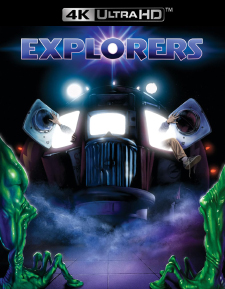
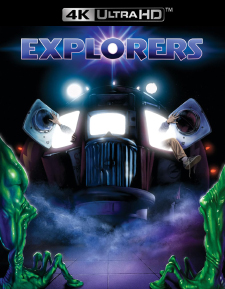
The Vinegar Syndrome Limited Edition 4K Ultra HD release of Explorers is a three-disc set that includes one Blu-ray with a 1080p copy of the film and a second Blu-ray with the bulk of the extras. The insert is reversible, featuring new artwork by JJ Harrison on one side and the original theatrical poster artwork on the other. There’s also a 40-page booklet with essays by Max Evry, Michael Almereyda, Gabe Klinger, and Patrick Dahl. Everything comes housed in a magnet box/slipcover combo that was also designed by Harrison. Limited to 8,000 units, it’s available direct from Vinegar Syndrome and a few select independent retailers, though it’s also available as a standard release minus the booklet and elaborate packaging. The following extras are included:
DISCS ONE & TWO: UHD & BD
- Commentary with the Movie Oubliette Podcast
The new commentary for Explorers features Conrad Chambers and Daniel Goh of the Movie Oubliette podcast, and it’s available on the theatrical cut only. Anyone expecting typical podcaster blubber might be put off at first, as Conrad and Daniel speak in measured, soothing tones all throughout the track—even when discussing people that they’re huge fans of, like Jerry Goldsmith. They note the differences between the two cuts, and also point out some of the missing scenes that weren’t in either cut and story concepts that were lost, like the idea of a world mind. They also do a lot of reacting to what’s happening onscreen, but they still cover a few practical details about the production and the cast.
DISC THREE: BD
- The Thunder Road (HD – 87:18)
- A Science Fiction Fairy Tale (HD – 64:48)
- Deleted Scenes (Upscaled SD – 33:56)
- Original 1985 Electronic Press Kit (Upscaled SD – 4:52)
- The Tale of the Farmer and the Wise Man (HD – 10:30)
- Gallery (HD – 5:24)
- Theatrical Trailer (HD – 1:33)
- Theatrical Teaser (Upscaled SD – 1:16)
- TV Spot #1 (Upscaled SD – :31)
- TV Spot #2 (Upscaled SD – :31)
The Thunder Road is a new making-of documentary produced and edited by Elijah Drennor, featuring archival footage and a whopping collection of new interviews: Joe Dante, Eric Luke, Robert Picardo, John Hora, executive producer Michael Finnell, editor Tina Hirsch, sound designer Mark Mangini, second assistant director Carol Green, visual effects supervisor Bruce Nicholson, model maker Bill George, VFX cameraman Patrick Sweeney, assistant cameraman Peter Daulton, animation supervisor Bruce Walters, and stop-motion animator Anthony Laudati, as well as film music historians Daniel Schweiger and Jeff Bond. (And if that’s not enough, Jerry Goldsmith, Rob Bottin, production designer Robert Doyle, and other members of the cast and crew appear via archival interviews recorded for the film’s EPK.) Together, they paint a portrait of the journey of the Thunder Road from conception to release, including the script, cast, cinematography, production design, makeup, visual effects, and the troubled editorial/test screening process. (Dante also explains his reasoning behind the alternate home video version.) It’s a great addition to the Explorers canon.
The new extras are rounded out by a Gallery, the original Electronic Press Kit from 1985 (which provided some of the archival footage for The Thunder Road), and Eric Luke’s 1976 student film The Tale of the Farmer and the Wise Man. It’s a multilayered, fourth-wall breaking story that’s as much indebted to Monty Python’s Flying Circus as it to anything else. However much that Dante may have been the one that helped reshape the finale of Explorers into something decidedly postmodern, Luke’s short film demonstrates that he wasn’t exactly unamenable to that kind of thing.
The rest of the extras are ported over from the 2021 Shout! Factory Blu-ray. A Science Fiction Fairy Tale is a making-of documentary featuring interviews with Dante, Luke, Ethan Hawke, senior production executive David Kirkpatrick, junior production executive Darlene Chan, and Ready Player One author/Explorers superfan Ernest Cline. It unavoidably covers some of the same material as The Thunder Road, but from different levels (Kirkpatrick and Cline in particular provide a bird’s-eye view of the production). The big draw, of course, is the fact that Ethan Hawke actually participated. He says that Joe Dante and Peter Weir were his early mentors, and that Dante is the one who taught him all about genre movies.
Finally, there’s an extensive collection of Deleted Scenes that can be played with or without optional commentary by Dante. They were sourced from a Beta tape workprint version that he discovered in a box in his garage. The missing footage plugs many of the holes in the theatrical cut, providing more backstory for Ben’s family life; better developing Lori’s character; showing more of what happened after the explorers return to earth; and finally resolving Charlie’s character arc. (The latter angle means more Dick Miller, and more Dick Miller is always better.)
The only previous extras that are missing here are two brief interviews from the Shout! Blu-ray, one with John Hora and the other with Tina Hirsch. But they’re both represented in The Thunder Road, and the new documentary alone makes Vinegar Syndrome’s set worth picking up—to say nothing of the huge improvements in video quality! This is one of my favorite releases of 2026 so far, and it’s a must-buy for Joe Dante fans who understand exactly what kind of film that it is. So, what are you waiting for? Put down what you’re doing and buy it, stat.
-Stephen Bjork
(You can follow Stephen on social media at these links: Twitter, Facebook, BlueSky, and Letterboxd).