
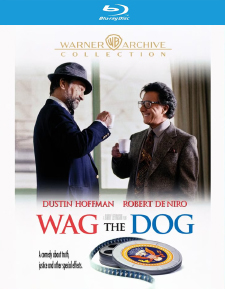
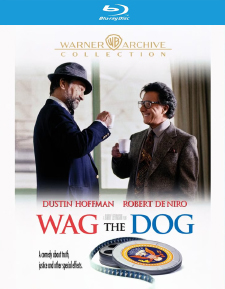
Wag the Dog (Blu-ray Review)
Director
Barry LevinsonRelease Date(s)
1997 (August 18, 2026)Studio(s)
Baltimore Pictures/TriBeCa Productions/New Line Cinema (Warner Archive Collection)- Film/Program Grade: A
- Video Grade: B+
- Audio Grade: A
- Extras Grade: A

Review
Satirical films can be problematic. If they don’t hit their mark or don’t have the right tone, they can easily tank. Successful examples include A Face in the Crowd, Dr. Strangelove and Network. Wag the Dog is a satire centered on a spin doctor who attempts, through unorthodox means, to direct the public’s attention away from a Washington scandal.
The President of the United States has just been credibly accused of having had sex with a minor in the Oval office bathroom and the press has become aware of it. The President’s top operatives call in spin doctor Conrad Brean (Robert De Niro) to quell the uproar. Brean hires Hollywood producer Stanley Motss (Dustin Hoffman) to create the illusion that America is at war with Albania. Brean and Motss are confident that the American media will be easily manipulated by fake denials, planted tidbits, and updates on impending conflict with the small European nation. Their hope is that manufactured war news will overshadow the President’s episode of pedophilia and keep his re-election campaign from derailing.
Brean and Motss have conscience enough not to actually start a war, though we’re led to believe that might have been the next step if their plan needed some embellishment. These aren’t patriots. They’re opportunists, each with a different motivation to accomplish the same goal. In that sense, they’re kindred spirits.
Casting is excellent. De Niro conveys authority and intelligence as Brean. After meeting briefly in a bunker way underground, he understands the situation and knows precisely what must be done. He calmly issues orders as to what he will need and he receives no pushback. He’s recognized by administration bigwigs as a master of spin and they trust him. Brean’s plan unfolds as expected, benefitting tremendously from Motss’ participation.
An egoist upset that Hollywood has never paid him his due, Motss recognizes that staging and filming a phony war could be his masterpiece. This is the ultimate challenge, and he has the knowledge and the tools to pull it off. Hoffman plays Motss so that even as he speaks, you can see he’s thinking ahead to the acclaim he anticipates. The only problem: this is to be a top secret mission.
Hoffman’s Motss is an amalgam of a Hollywood mogul, some stereotypical behaviors but mostly original quirks. Much of the dialogue is walk-and-talk, giving us a chance to see Motss in his element, dressed in white when headed out for a game of tennis, marching though a set like Napoleon on a conquest, and confidently taking charge of a monumental fakery.
The excellent supporting cast includes Anne Heche, Kirsten Dunst, William H. Macy, Denis Leary, Willie Nelson and Woody Harrelson. Unlike De Niro’s calm and collected spin doctor, Heche’s Winifred Ames is the voice of practical reality. She’s fearful of the fallout from the President’s sex scandal. Heche’s darting eyes, body language, and on-edge demeanor suggest a woman constrained by time to make a very bad situation go away. She stresses about risks in the operation that others in the inner circle treat as just another job.
Harrelson is cast as heavily medicated Sgt. William Schumann, chosen to play a fabricated war hero to rally the country. Harrelson appears only in the last third of the film, but he manages to steal his few scenes. Dunst plays actress Tracy Lime, hired to portray a mother, baby in arms, escaping a bombardment with the help of CGI. Nelson plays songwriter and singer Johnny Dean, hired to write a patriotic anthem to inspire the public in America’s “war” with Albania.
The screenplay by David Mamet and Hilary Henkin tackles many things: abuse of power, a media eager for the next big story, unscrupulous fixers, a public unquestionably accepting of what it hears and sees on TV, and huge egos. It’s all here in a beautifully nuanced film that derives its power from sharp dialogue delivered by expert actors in the service of a meticulously crafted plot. The principal characters are professionals doing a job. They’re apolitical. Their job is using their expertise and skills to accomplish a clear goal. For their efforts, they’re well paid. These aren’t villains in the traditional sense.
Director Barry Levinson, working with first-class material and two fine actors, delivers a highly entertaining cautionary tale about political corruption and the people whose self-interest lies in burying it. Released in 1997, the film seems particularly relevant today with the current administration’s proclivity for distracting the public from embarrassing issues by playing up others. The media, hungry for headlines, often fall for the ploy. Wag the Dog was made during the Clinton administration when the Monica Lewinsky scandal was grabbing headlines. Today, however, the film is no less pertinent.
Wag the Dog was shot by director of photography Robert Richardson on 35mm film with Panavision Panaflex Platinum and Panavision Primo lenses, the results of which were processed photochemically, and presented in the aspect ratio of 1.85:1. The Blu-ray from Warner Archive features a new 4K scan from the original camera negative. Details are nicely delineated, including fabrics in clothing, filming equipment on a Hollywood sound stage, and objects in Stanley Motss’ home. A brief poolside scene has a dreamlike feel as Stanley lounges and plans how he will engineer his Big Lie. Political commercials are seen on screens throughout the film for both the President and his challenger. These have an intentionally grainy quality reflecting the TV technology of the day. Early CGI is shown when a young actress (Kirsten Dunst) is hired, dressed as an Albanian woman with a baby in her arms and made to appear to be running from wartime shelling.
The soundtrack is English 5.1 DTS-HD Master Audio. English subtitles are an option. Dialogue is clear and distinct in this dialogue-driven film. Background ambient effects can be heard throughout. Mark Knopfler’s score is used sparingly, never overpowering Mamet’s pointed dialogue.
Bonus materials on the Blu-ray release from the Warner Archive Collection include the following:
- Audio Commentary by Barry Levinson and Dustin Hoffman
- From Washington to Hollywood and Back (24:43)
- Q&A: William H. Macy on Mamet (5:58)
- Theatrical Trailer (2:34)
Audio Commentary – Director Barry Levinson and actor Dustin Hoffman share this commentary, providing information about the planning and filming of Wag the Dog. The political commercials shown in the film had to be designed beforehand. Many scenes were shot in “pure continuity” on a 29-day schedule. This helped actors with their characterizations. To a spinmeister, there’s no sense of morality. He’s a hired gun who solves problems and “puts out the fire.” He does the work required and then blends into the woodwork. Dustin Hoffman became involved through Tribeca, De Niro’s organization. Hoffman sent the script to Levinson, who had problems with it but liked its level of deception. He consulted with co-screenwriter David Mamet and they shaped the script in that direction. Mamet came up with all the scenes of fakery. Hoffman speaks about improvisational moments that register with audiences. The stronger the script, the less one has to rely on improvisation. Hoffman says he was channeling his father in many ways in his portrayal of Stanley Motss. Producers and executives often feel that can “do it all.” With many actors in a scene, different rhythms occur. Often moments are discovered that work for the piece and they can be built on. Levinson speaks about “breathing room”—incorporating visual sequences to get away from dialogue—to prevent the viewer from getting dialogue overload. He mentions the poolside scene as an example of this. Levinson wanted a “ragged elegance” look to Wag the Dog, and worked with director of photography Robert Richardson to achieve it. Lighting was sometimes very dramatic, color palette was muted and generally avoided bright primary hues. Occasionally, color jumps out. A patriotic song allows for a musical interlude. During the cast read-through, Levinson was upset with Hoffman because he wasn’t into the role. De Niro tried to placate Hoffman. Levinson told him to pare down his performance. Hoffman says that there’s always a committee involved in making a movie. A satire must be based on a few happenings in life and then accelerated. It should take a point of view. Hoffman compares Willy Loman in Death of a Salesman to Stanley Motss. Both want to do something successful. Stanley feels he’s never gotten due recognition by his peers. The constancy of being human is feeling insignificant. The need to be successful sometimes takes the place of love in one’s life.
From Washington to Hollywood and Back – Director Barry Levinson never shows the President in Wag the Dog. The film is about reality vs. artificiality. Budd Schulberg talks about his screenplay for A Face in the Crowd, a film about how television can corrupt. Films provide a learning process and a warning. Comparisons are made between Wag the Dog and Network. The latter was prescient, since network news today has become sensationalist. Tom Brokaw of NBC News speaks about the need for attracting audiences. It’s important for TV news reporters to “light up a room.” There’s a mutual attraction between Washington and Hollywood. The danger is that TV’s impact on society has fostered mediocrity—simplistic, twice removed from reality. “A lot of movies are cartoons.” These days, many have become more skeptical about news and what they see on television. Film footage can easily be faked. How often it will happen is the basis of Wag the Dog.
Q&A: William H. Macy on Mamet – Actor William H. Macy speaks about screenwriter David Mamet, referring to him as “a certified genius.” There’s poetry in his writing. He can imitate any style, write in iambic pentameter, and tell jokes joyfully. His perspective on things is unique and his major goal is to tell a story honestly. Mamet loves America and American speech patterns. His politics are “kind of wonderful.”
A black comedy with not many laugh-out-loud scenes, Wag the Dog is a scathing indictment of how a big lie can be foisted on the American people by media manipulation. The film addresses the lack of morality in modern media and politics. It shows the ease with which experts can deter attention from troubling behavior in high places by creating “breaking news” that will sweep unpleasant reality under the rug to rescue a campaign for re-election. With clever dialogue, top-notch performances, and contemporary relevance, Wag the Dog is essential viewing.
- Dennis Seuling